

In this insightful opinion piece, Dr. Sujit Narayan Chattopadhyay explores the delicate balance between social safety nets and industrial stagnation. While acknowledging the developmental potential of welfare, he warns that West Bengal’s current „Fiscal Populism“ may be sacrificing long-term structural transformation for short-term relief.

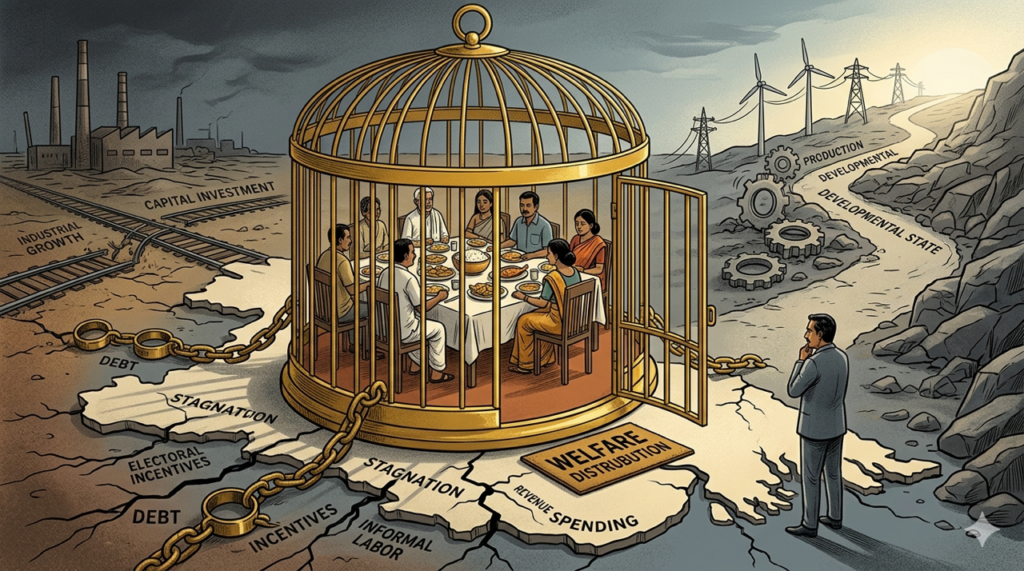
Between compassion and capital: In contemporary development discourse, economic policy is often treated as a clinical exercise in ledger-balancing. However, West Bengal’s trajectory suggests a more complex reality: policy is an extension of political survival and institutional history. We stand at a juncture where the noble goal of social justice risks being decoupled from the productive engines that make such justice sustainable.
From distribution to productive welfare
Historically, the „Developmental State“ model in India rested on two pillars: public investment and the upliftment of the marginalized. Modern development theory, particularly the Capability Approach, suggests that welfare is not merely a „drain“—it is a precondition for growth. Investments in health and education are, in fact, investments in labor productivity and demand stabilization.
However, my analysis of West Bengal’s recent budgetary data reveals a concerning structural imbalance. Nearly 90% of the state’s total expenditure is now consumed by revenue spending—salaries, pensions, and direct transfers. While these transfers provide a vital floor for the vulnerable, they are increasingly crowding out capital expenditure, which has stagnated at 10–12%. We are faced with a paradox: we are strengthening the consumer today, but failing to build the infrastructure that employs them tomorrow.
The trap of fiscal populism
This shift is rooted in „Fiscal Populism“—a byproduct of intense democratic competition where electoral incentives favor immediate consumption over long-term structural change. With a debt-to-GSDP ratio hovering around 40%, the state is effectively borrowing to fund current consumption rather than future production.
This is particularly critical given the state’s 80% informality in the labor market. While social safety nets provide a necessary cushion, they cannot replace the „ladders“ of economic mobility. Without a robust industrial base, welfare becomes a permanent necessity rather than a bridge to formal employment. This is not a new phenomenon; it is the culmination of a long-term post-industrial decline that has plagued the region since the late 20th century, exacerbated by persistent land and capital constraints.
The challenge of institutional integrity
A critical, yet sensitive, dimension of this model is the political mediation of welfare. For redistribution to be truly developmental, it must be universal and transparent. When the delivery of benefits becomes intertwined with administrative discretion and local political structures, it risks undermining institutional integrity.
To transition from a „clearinghouse for cash“ to an „engine of production,“ the state must ensure that welfare reaches the citizen as a right, not as a political favor. Preliminary observations of administrative patterns suggest that the efficiency of these transfers is often hampered by these „mediated“ delivery channels, leading to leakages that stifle the intended economic multiplier effect.
A call for integrated policy
This critique is not an argument against welfare, but a call for its institutional integration with industrial policy. To reclaim economic dynamism, West Bengal must pursue a „Third Way“:
- Welfare as an input: Realigning social spending to directly enhance labor skills and market readiness.
- Reclaiming fiscal space: Prioritizing capital formation to break the cycle of rising debt and industrial stagnation.
- Historical contextualization: Addressing the legacy of industrial flight through targeted reforms in land and labor governance.
Without this recalibration, we risk a future of „subsidized stagnation.“ We owe it to the next generation to ensure that West Bengal is not only a compassionate state but a productive powerhouse where welfare and growth are two sides of the same coin.
About the author:
Dr. Sujit Narayan Chattopadhyay is a political scientist specializing in political theory, governance, and the political economy of public policy. His research offers a rigorous and critical engagement with economic policy, redistribution, and state–society relations, with a particular focus on the Indian context. He has made substantive contributions to contemporary debates on democracy, justice, and governance through theoretically grounded and empirically informed analyses. Dr. Chattopadhyay’s scholarship is distinguished by its integration of classical and modern political thought, including sustained work on Marxist theory, social contract traditions, and deliberative democracy. His research advances interdisciplinary perspectives by drawing on economics, sociology, and philosophy to illuminate the complexities of policy and governance. In addition to his research contributions, he is actively engaged in the production of advanced academic and textbook-oriented materials, particularly in political theory, aimed at strengthening higher education and scholarly discourse. His work reflects a strong commitment to analytical clarity, conceptual depth, and policy relevance.