


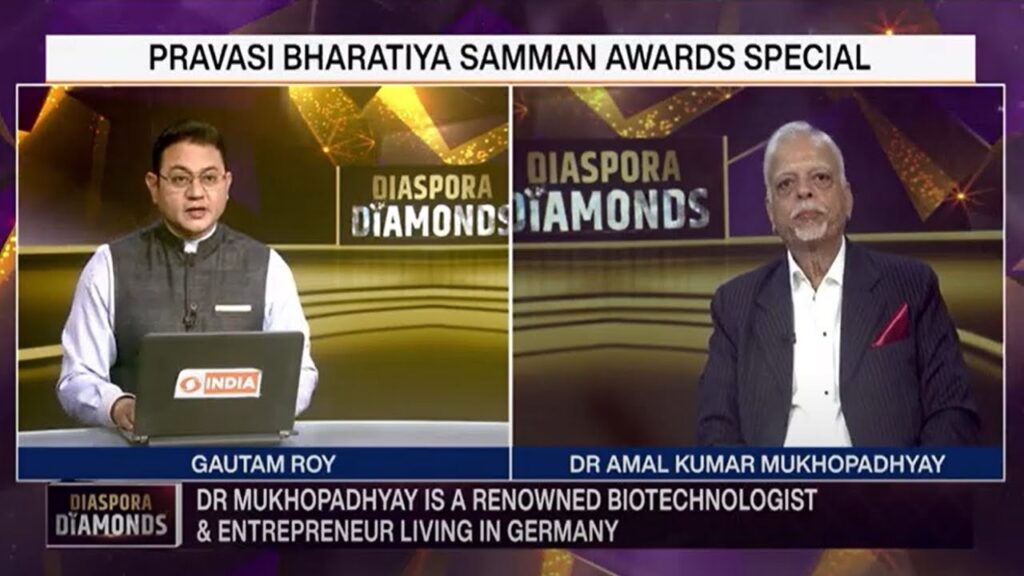

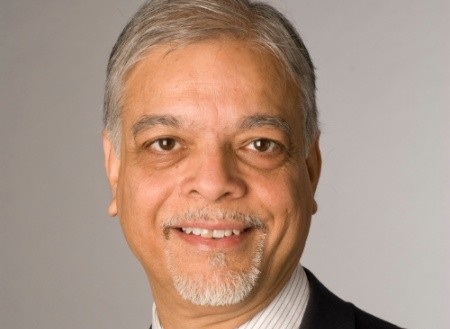
Amal Kumar Mukhopadhyay (*1946), a biochemist and serial entrepreneur born in India, is the founder of the Hanseatic India Colloquium and has lived in Germany since 1975. In this interview, he recalls his early integration – emphasizing that learning German was key – describes the changing landscape for international professionals, and reflects on his path from academia to founding biotech start-ups and promoting sustainable innovations. He also shares his vision for strengthening India-Germany collaboration, the impact of receiving the Pravasi Bharatiya Samman Award, and his ongoing dedication to connecting people, ideas, and opportunities across borders.
You moved to Germany many years ago to pursue your scientific career. What was your integration process like back then – both socially and professionally?
I first arrived in Germany back in 1975 and was immediately shocked to understand that I was expected to communicate only in German. I may say that my knowledge in German was just rudimentary, almost nil. We were a group of eight young men from India all having received postdoctoral fellowships in different subjects. Our destination on arrival in Germany was the Goethe Institute in Lüneburg. Our first assignment was to learn German as good as we could for a period of three months. At this time, we were not supposed to bring our family members with us, and I was supposed to stay as a guest with a German family. So, we are obliged to speak no other language than German, except for the time spent with other seven Indian scholars. So, it was intensive language learning session. In Lüneburg people were used to having foreign citizens as the Goethe Institute there attracted many foreigners to come and learn German.
After the German learning course was over and after I received the certificate, I moved to Hamburg to join my workplace at the University Hospital, UKE, in Hamburg. Professionally and socially, I felt very welcome. The Foreign Students Centre at the University of Hamburg was very helpful in finding me a family accommodation almost immediately after my arrival here in a student’s residence of UKE. This will not be the case now, as finding an accommodation is really tough in the urban areas of Germany, as we have observed in recent years.
In summary, I must say that I have felt so welcome from the day one in Hamburg and it has not changed a bit till today.
How has the situation changed for international scientists and skilled professionals coming to Germany today?
Indians have been generally liked in Germany and basically German citizens then and now always welcome Indians. This is especially true in Northern Germany although I have experienced some not so friendly situation in Eastern Germany.
International scientists and tech experts are considered very valuable to German economy and hence they are cordially accepted in their professional sphere and if they show some ability to communicate in German then socially, they are considered to most acceptable. I think to get integrated; the key is to learn the language and the rest falls into right places.
You have founded several biotech start-ups over the years. What were some of the biggest challenges you faced as an entrepreneur?
Setting up Start-ups in Germany is not easy, as German business-leaders do not tend to take start-ups seriously, at least a decade or so ago. In 1995-1996, it was different, as many Start-ups (this name was not coined then) especially in IT sector crowded the marketplace. So, people talked about IT boom and soon thereafter a biotech boom started. On 10th March, 1997, a new stock market segment, called Neuer Markt, with telecom and IT service companies on its list, started its operation. It was exciting time. Many biotech companies came in soon thereafter and many got listed in Neuer Market exchange. Evotec was a prominent name, with which I too was associated in minor way, at that time. I founded my first biotech company, Agelab Pharma GmbH, a proteomic company but we were perhaps ahead of time, and the technology was not mature in 2002. After that I set up ElGa Biotech and the name was derived from the rivers Elbe and Ganges implying our efforts to build bridges between two nations as Elga was focussed on promoting Biotech/Pharma cooperation between Indian and German companies.
What inspired you to start Lorven Biologics recently, and what is the company focused on today?
As I was getting older, I realised that too many chemicals are messing up our food, the clothes that we wear, the water that we drink or even the air that we breath. The idea of Lorven was born out of the concept that we use the power of biotechnology to produce natural products, in laboratory or in fermentation facilities, that could help us to replace chemicals with these natural products in our daily life. It could be natural colours in textile dyeing, in household products, or in cosmetics or even in food. Another example is replacement of microplastics with biodegradable biological Material. And the list can go on.
The Hanseatic India Colloquium has become a well-established platform connecting India and Germany in the pharma and biotech sectors. What was your vision when you launched it?
Hanseatic India Colloquium was born out of the concept of ELGA – building bridges across two continents to bring academics, scientists and industrialists especially in pharma and health care sector from India and Germany on one platform together just to light a spark of cross border cooperation. We started in 2006 and continuing till this year. So, I feel very satisfied that this concept has survived so long and its relevance is felt even stronger now.
How have you managed to bring together so many stakeholders across industries and borders?
It was an easy job for me, as all stake holders whether in India or in Germany, felt strongly for a need to cooperate. India was a growing unexplored market for the Germany, but they were unsure about the pitfalls of Indian market and Indians knew if Germany accepts their products, then the world is open to them. They just needed a platform to interact with likeminded partners, and we created this platform in the form of Hanseatic India Colloquium. So far, we have been doing it as one day Conference, I wish in future we should extend it by another day or at least half a day by bringing in younger research scientists or start-ups who may present posters or short presentations. All such posters/ presentations should have a clear application-oriented focus – not just academic research. Hope this will be possible in future.
In 2023, you received the Pravasi Bharatiya Samman Award – India’s highest honour for overseas Indians. What does this recognition mean to you personally?
This award is a source of great motivation for me to do even more and to motivate others to join me in giving back to the nation where we come from. I felt so humbled and at the same time honoured to receive the award from the highest representative of India, the President. This award also helps me in getting resources mobilised as most people have a respect of such an award.
Through the Hanseatic India Forum, you and your team support charitable initiatives and promote a “help for self-help” philosophy…
The Hanseatic India Forum was launched in 2009 as a registered charitable body to promote cultural, educational and developmental cooperation between Germany, especially Hamburg, and India. Many diaspora members and my German friends, especially Mr. Dieter Grützmacher and Ms. Petra Stegemann, who were interested in India joined in as my compatriots. After having done two Indo German Colloquia in Hamburg, it was felt necessary in 2008 to have an Organisation that can then propagate the idea of Indo-German friendship and cooperation. It was about a decade after the end of the cold war and India has started liberalising its economy and opening to the West. Both Germany and India have started to get closer politically and economically. Therefore, we thought that our initiative in Hamburg will be both timely and fruitful.
Hanseatic India Forum or HIF in short, in the first few years was focussed on organising Indo German Conferences on scientific, educational and application-oriented topics, with both academic and research oriented industrial companies participated.
We were organising several cultural event starting in 2010 with a book reading event, “Masala Highway – Eine literarische deutsch-indische Begegnung”. This was a book written very humorously but very factually by Gabriel A. Neumann. Many such events followed.
However, the members of Hanseatic India Forum were becoming restless as they wanted to make “India” in the name of HIF to count and all wanted that we should plan to carry out developmental projects in India. Such projects require financial support from benevolent Institutions, Trusts and Foundations.
You became active in the Sundarbans…
Indeed, to start with, we focussed on rural interior areas of Sundarbans in West Bengal, India. Our first project here was to establish “Solar Medicus” in village hospitals and community health centers. This was small independent units of Solar Powered Health Services, which included solar panels, transformers, battery storage, LED operation theatre lamps and a small solar powered refrigerator. This turned out to be a boon for emergency medical operations, and delivery of babies during the nighttime when electricity from grid was often not available. The refrigerator could store various life saving medicines, like anti snake venom antisera, anti-rabies vaccine, RH incompatibility etc. that needed to be stored at low temperatures. This saved hundred of lives every year.
How do you empower women in rural areas?
We focussed on skilling of the village women so that they have an opportunity to earn some income while staying in their villages. Such employment opportunities are usually rare in villages forcing them to migrate to cities leaving their families at home. If the village women acquire a capability to generate income for themselves, then their social status get uplifted, and they have a say in their family affairs like sending their daughters to schools and colleges avoiding early marriages. So we decided to start a project where village women were trained in baking technology, and they were provided with a completely running bakery with all equipment installed. Thus, Sundarbans German Bakery was born in 2013, and it has provided employment directly close to 75 women thus benefitting 75 families. Indirectly job creation level, as estimated empirically, reached three or four times more. The bakery, managed by Sundarbans Women Self Help Group Cooperative, is running profitably, without any external financial support. The profit generated are used to employ more women or to support other community-based projects.
What is the Forum currently working on or planning for the near future?
With the success of this project, we have now decided to clone the idea and set up another Bakery in another remote part of India, on Sagar Island. This Bakery will be inaugurated later this year, and we all hope that it will be successful too.
Apart from the Bakery, recently we have started a project to support a tailoring and swing unit, “Ila Gouri Hasto Shilpo Kendra” (Ila Gouri Handicraft Training Center) at Nandakumar Pur, Soth 24 Parganas, West Bengal. Right now, ten village women are receiving training in sewing and tailoring and the products made by them will be sold in local markets. We hope that in coming years, this unit will also become financially independent and at least a dozen women will find employment.
Before I end this section, I must mention that all our developmental projects in India are carried out in cooperation with Sabuj Sangha, a local NGO, which is very efficient in implementation, very transparent in its accounting and has thorough knowledge of the needs of local community. Sabuj Sangha is led by Mr. Ansuman Das, the Director, a renowned person in community welfare projects.
Are you working on other regions as well?
Yes, we are also working in India together with the Centre for Environment and Development (CED), Thiruvananthapuram, Kerala in India. We are doing these projects related to the protection of environment in cooperation with CED and with the support of GIZ (Deutsche Gesellschaft für Internationale Zusammenarbeit, German Agency for International Cooperation), for the last few years. Our first project was focussed on training and transfer of knowledge in modern technologies for solid waste disposal. Our ongoing project is focussed on the recovery of wastewater. In highly water scarce regions of this world, like in India, it is absolute mandatory to understand that wastewater should not be wasted and there are technologies available to recover most of the so-called wastewater.
In the future, we will remain committed to projects relevant to social uplift of village women in India, providing them with skilling and income generation opportunities and on environment related projects like coastal protection and carbon sequestrations by mangrove planting and water resource managements.
Looking back on your long and eventful career, how would you comment? What advice would you give to the next generation based on these experiences?
First, I must say that I am very satisfied with the way my life has flown over the past eight decades and I am not sure if I could have done better by changing its flow and course. I was very happy that I decided to come over to Germany for research and higher studies. Here I found friends, colleagues and a very welcoming milieu that allowed my capabilities to flourish. At the same time, I could keep a very intense and fruitful relationship with my family members, friends and professional colleagues in India. I think keeping this bidirectional relationship was crucial for making what I am today. To modern generation of young Indian professionals who are arriving in Germany and plans to change their nationality to stay in their new homeland permanently, I would strongly recommend to keep both your motherland and your adopted fatherland in the focus of whatever choice you make with your lives, learn the local language and culture as best as possible and be always on the look out for opportunities to help young people left back home so that they also can fulfil their dreams like you have done.
Finally in this context, I would like to say a couple of sentences for theinder.net. This digital platform has been for me, a beautiful online window from Germany to India. For this, I must congratulate you, Bijon and your team for making this platform so relevant for us, the diaspora living in Germany. theinder.net over last many decades has provided a platform for diaspora to keep in touch with their motherland and provided valuable information to our German friends who are interested in India. I have only love and respect for the young people dedicating their time and efforts to keep this online platform so vibrant over the past years and I convey my best wishes to them to keep it successfully going for many decades to come.
Thank you for these motivating words.
Additional links:
- Hamburger Mukhopadhyay mit indischem Zivilorden ausgezeichnet
- Deutsch-Inder von All India Institute of Medical Sciences ausgezeichnet
- „Unterschiede in der wissenschaftlichen Ethik zwischen Indern und Europäern“
- Gesundheit für indische Dörfer
- Biotechnologie: Ein deutsch-indischer Dialog am 24.8.18 in Hamburg
- Künstliche Intelligenz im Fokus: 14. Hanseatic India Colloquium bringt Expert:innen aus Indien und Deutschland zusammen
- Indo-deutscher KI-Dialog: Innovation durch Zusammenarbeit