
Most languages, extinct or extant, were never written. Writing is today so very much established, it is hard to grasp it ever was otherwise. Dr. Shantanu Mukherjee attempts an explanation for us.
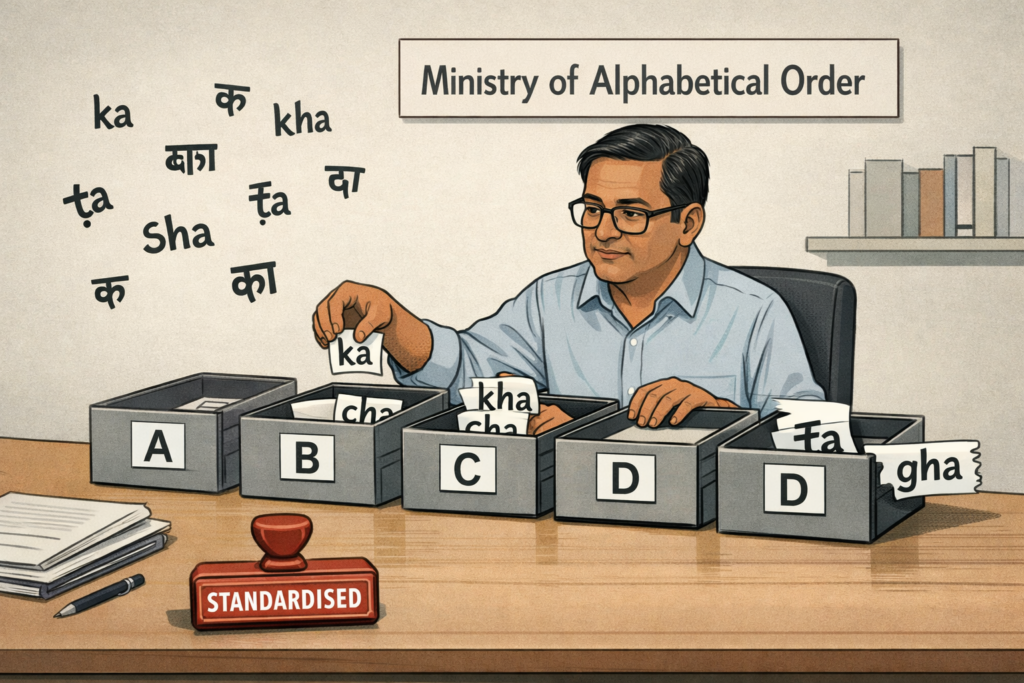
Writing emerged in Mesopotamia. Sumerians, Akkadians, as well as Egyptians on the Nile and later the Hittites of Anatolia – they all wrote. With various techniques. And so they left their legacy accessible beyond their own times. The invention of writing is one of mankind’s supreme achievements.
But none of them wrote with an alphabet. Alphabets came later, gradually metamorphosed out of then existing systems.
But what is an alphabet? The essential feature here is the sound – and not the meaning. Simply put, all its ancestral systems, like cuneiform or hieroglyphs, looked at things, representing, especially in the earliest versions, each thing with a different symbol. In contrast an alphabet represents sounds not meanings.
But there is a firm bridge between sound and meaning in every alphabet. Suppose you encounter a language that so far has been all speech and no writing. How do you go about taking speech sounds and matching each to a ‚letter‘, this letter being an element out of a closed set whereby the set is the alphabet?
The trick, simple and ingenious, is to consider all and only those speech sounds that are minimal distinctive.
What is minimal? And what is distinctive? A distinctive sound is a speech sound that stipulates change in meaning. B, M, C, H for instance are distinctive sounds of current English because switching places in an otherwise identical sound environment they signify systematic changes in meaning. As in BAT, MAT, CAT, HAT etc.., ‘the otherwise identical” sound environment’ being …AT.
”Systematic” is here meant to stand for among other things:
Regular: ( that is, the meaning-switch is not eccentric. B,M,C,H, etc. nearly at every occurrence generate a change in meaning, the rest remaining constant),
Consistent: (that is, not whimsical inasmuch as their function is not affected by change in the sound frame: CAT, BAT, MAT… as well as COLD, BOLD, HOLD…HOUND, BOUND, MOUND….)and hence
Predictable: (that their meaning-affecting influence is destined to be valid in any other environment yet to be encountered. eg. BAD, HAD, RAD, MAD, SAD or BULLY, FULLY.. Or BUG, MUG, HUG….). And evidently the frequency of occurence is
Unsaturated: That is, there are gaps in lexicon: there are no MULLYs or HULLYs next to BULLY etc.
What is ‘minimal’? If we consider meaning-change only it could be argued that in the unchanging frame ….TION, TRANSI, EXAMINA, OP, VINDICA etc. kindle different meanings. Are we then to introduce for TRANSI, EXAMINA etc. a letter(representative) each while constructing an alphabet? Well, no, ‘minimal’ saves the day.
As can be easily demonstrated, TRANSI etc. are in a way distinctive but none is a smallest unit (atom) of speech-sound. T R A N S I are constitutive to TRANSI and are all members of the set of smallest sound units (TRANSI is rather a molecule).T, R, etc. are distinctive (meaning-affecting) and minimal (smallest), TRANSI is in the above sense distinctive – but not minimal. Every alphabet ought ideally to tally with all and only the minimal distinctive sounds of its specific language. Thus the thing is to locate all such sounds and give each its own name. And to see that TRANSI. VINDICA etc. do not demand their own ‘names’. These ‘names’ are generally called letters(of the said alphabet – Our Bs, Ms, Cs and Hs above).These minimal distinctive sounds are often called “phonemes”.
A note of caution here. Strictly, a phoneme in many linguistic theories is in fact no unit of sound, be it minimal or distinctive. It is an abstract concept. Possibly the best ‘description’ of a set of phonemes would be a negative definition: given a set of phonemes which we here for convenience call A,B,C,……..Z the individual phonemes are then defined as follows : A = not B, not C,……not Z ; B = not A, not C,……not Z ; C= not A, not B, not D,…..not Z.etc..
Two general features of every alphabet are crucial: arbitrary and normative, Of these, arbitrariness is almost automatically delivered. It means there is no intrinsic bond joining a letter to a certain sound – no more than a ‘word’ is married to a concept. There is nothing in the word ‘tree’ or in the idea of a “tree” (treeness) that would pair the two., That the two go together is mere convention, an arbitrary pair set by a certain speech community, There is the famous adage attributed to the Irish playwright Bernard Shaw’s suggesting the spelling “ghoti” for the (meaningful) sound ‘fish’. Looked at from closer quarters: gh like in ‘enough’ (=f), o like in ‘women’ (=i) and ti like in ‘nation’ (=sh), That ‘fish’ is written as ‘fish’ is an accident of history. At birth it was utterly arbitrary. Standardized spelling is only on second count a lingual issue. Primarily, it is, to put it a trifle clumsily, “sociopolitical” .
But once the standard has been set, there better be no vascillation, no unsure spelling. The norm must now be strictly mastered and observed lest slipshod spelling lead otherwise to chaos while writing.
Here too an anecdote of the teacher who asks his pupils to spell “pillar”. Out come answers like “piller”, “pilar”, “pillar” etc. The teacher, himself unsure, makes no further comments and continues with his day’s chore. HIs pupils however, inquisitive children, demand the correct answer. Upon this says the the teacher calmly: “pillar with one l or two is – well both are correct, but two make the pillar more stable”. An established norm is expected to make precisely this answer impossible.
Ideally, an adequate dictionary ought to leave no room for doubts and uncertainties. Standardized spelling is a stabilizing, and hence welcome, dogma. A few other points matter too:
- Economy – assures elegance. English for instance has no single letter for a very frequent palatal sound like in SHort or SHave and turns therefore to a pair of letters. This is a breach of economy, though mild.
- One-to-one Correspondence – ideally, every letter should correspond to one, and only one, minimal distinctive (phoneme) sound and vice versa. The english U in pUt matches a sound quite different from what it is in bUt and so – violates this principle.

Editor’s note: Dr Shantanu Mukherjee is a linguist and long-standing university lecturer and, since 2026, has been contributing his own column, „Spektrum Europa“ („Spectrum Europe“), to theinder.net (press release – in German).