
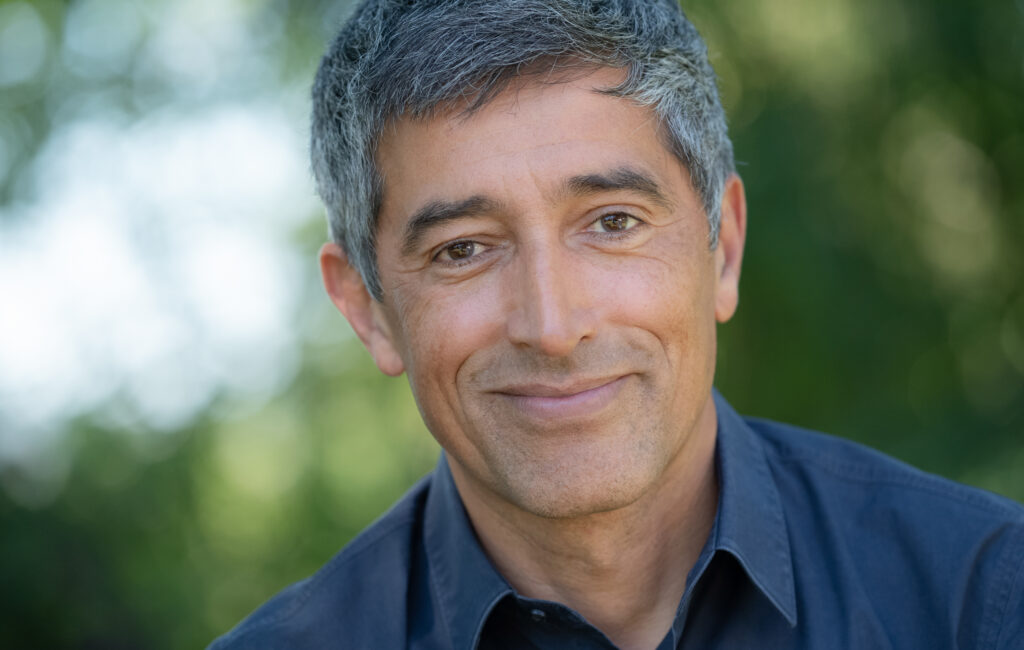
Ranga Yogeshwar (born 1959) is a science journalist from Luxembourg. He spent his early childhood in India, his father’s homeland, and became a familiar face on German television in the late 1980s, known for presenting science to the public in an engaging and accessible way. Today, Yogeshwar is a renowned author and commentator who approaches science and world affairs with curiosity and openness, dedicated to making the pressing issues of our time understandable to a broad audience. In this conversation, he speaks with us about India and its search for a role within a shifting global order. He discusses China’s strategic advantage, the West’s struggle to redefine its identity, and why the recruitment of skilled workers from abroad reveals that Europe has yet to outgrow its colonial mindset. He also considers whether India is, in truth, merely a “paper tiger” – and why Google, despite its many Indian engineers, is not an Indian company. Finally, Yogeshwar offers a sharp critique of Western hubris and explains why, despite the challenges of climate change and global conflict, there are good reasons to look to the future with confidence – provided we learn to see the world from a new perspective.
Mr Yogeshwar, theinder.net was founded in 2000 — at a time when, during the North Rhine-Westphalia election campaign, CDU candidate Jürgen Rüttgers made headlines with the disparaging slogan “Kinder statt Inder” (“Children instead of Indians”). A quarter of a century later, the world has changed entirely: Germany is urgently dependent on skilled workers from countries such as India, while both India and China have developed new self-confidence and emerged as major global powers. How do you assess this shift in the global balance — the changing weight of these once so-called “Third World” nations?
When I first began working in Germany in the 1980s, India was synonymous with Mother Teresa and The Tiger of Eschnapur. Whenever I said, “I’m from India,” people would respond with a kind of sympathetic pity, and the conversation would quickly turn to poverty, to how dreadful everything supposedly was, to the caste system and all the familiar clichés associated with the country.
Today, when you say that you’re from India, interestingly, the conversation now turns to the country’s remarkable IT capabilities, its engineers, and its economic growth.
So, over the past twenty-five years — or more — we’ve witnessed a dramatic transformation shaped by several factors. For one, nations such as India and China have caught up industrially in many areas. Today, they are global heavyweights. Just look at electromobility, where China has become a world leader, or at computer science, where India has built a strong foundation. India now trains far more engineers than Europe does. According to OECD projections, by 2030 — not all that far away — around 27 per cent of all scientists and engineers worldwide will come from India. You can see this shift clearly when you look beyond Europe — for instance, at the United States, where Indians are highly visible across the tech industry. Many executives — take Google’s CEO Sundar Pichai, to name just one — have Indian roots.
That means that, on the one hand, these countries have simply become stronger. On the other hand, Europe’s own sense of identity has changed. Let’s not forget: for at least the past four centuries, Europe’s prosperity has also depended on a vast imbalance rooted in colonial structures. India — like many other countries in the Global South — was, in essence, first a supplier of cheap raw materials and later a source of cheap labour. These systems brought Europe considerable wealth. But that transmission belt is now beginning to slip, because we are living in an era in which those old power structures are undergoing a global realignment.
This transformation has inevitably created a sense of uncertainty across Europe. There is much discussion about where the continent will stand in the years ahead — and what role it can play as a global actor, positioned between the United States on one side and emerging alliances such as the BRICS nations on the other.
At the same time, the centre of expertise has begun to shift. The technological dominance that, thirty or forty years ago, was firmly anchored in the West — when the finest machines and innovations came from Germany, Europe and the United States — has, in many respects, been reversed. Europeans often find this change more difficult to grasp than Indians or Chinese, for whom this period represents a time of extraordinary momentum and a genuine sense of optimism about the future.
In Europe, by contrast — and in Germany too — one senses a growing unease. Many people fear that their children may no longer enjoy the same prosperity they did. Yet I remain optimistic, because I believe that, taken as a whole, the world is moving towards greater fairness and balance.
If you simply take a globe and look at the sheer size of these countries — not to mention their populations — it becomes clear how easily we forget that the Indian “continent” alone is home to more people than Europe and the United States combined. Here in Germany, that should encourage us to approach this new era of global cooperation and coexistence with confidence — but also with a broader, more nuanced perspective.
We’re currently witnessing how the existing world order — one based on certain rules and institutions such as the United Nations — is being challenged by countries like India and China. What, in your view, lies behind this? Do these nations intend to replace the Western-dominated order with a new one in which they themselves play a more decisive role? And how should alliances such as the BRICS — or, for that matter, those between China and Russia, or India and Russia — be seen in context?
Let me give you an example. We are dealing with institutions that were, in the past, tailored to a world dominated by Europe and the United States, in other words to what we call the West.
Take the United Nations Security Council. Its permanent members are France, Russia, the United Kingdom, the United States and China. India is not among them. One might well ask whether, given the weight of such a large nation, it is fair that it is excluded; whether it makes sense that France has a seat while no Latin American country does; and whether it is right that the entire African continent is not represented at all.
What we can see is that, in institutions such as these – and in many other areas as well – we are still looking at the world through an old perspective. It has become urgently necessary to change that perspective.
There are two ways of doing so. One is to shift that perspective, which would mean that the West shows greater openness and acknowledges that the cards need to be reshuffled. If that doesn’t happen, if we retreat into ourselves, the same thing will occur on the other side. And that is precisely what we are seeing today: all those nations that do not feel heard by us are coming together. This leads to developments such as the BRICS countries and similar alliances – that is the alternative path.
I personally believe we would do well to embrace a new openness and honesty in how we engage with these nations, and to resist being drawn into a narrative that carries the scent of conflict and sets us against one another.
Does that mean, from a European perspective, that we now find ourselves caught between two chairs — between the United States on the one hand and new alliances such as the BRICS bloc on the other? Do we have to choose a side, or do you see a realistic prospect that we might benefit from both?
I think the first step is to act with greater confidence and independence. In the past, we have too often seen a Europe too closely tied to a world led by the United States — a consequence of the Second World War and the Cold War. But now we need the initiative to say: we Europeans are independent, we are different. And we don’t need to wait for Washington to speak before we find our own voice on global matters.
That, of course, requires a confident Europe. And at the moment that confidence is lacking. What we see today is a very mixed picture within Europe: some nations tend to follow the United States, while others are trying to distance themselves from that. Added to this are economic interests that often lead to inaction. But in the long run, that is not a sustainable path.
In my view, all this has to do with the fact that we Europeans must finally recognise that the world is not divided into black and white. It is far more complex — made up of many countries, many cultures and many different ways of approaching things. And we should move beyond the notion that our values and our systems must be exported to everyone else, because, quite frankly, that approach has not worked particularly well in the past.
And where do you see India in this global balance of power? At first glance, the country appears to be on the rise, alongside China and the other BRICS nations. Yet India is also struggling with significant shortcomings, both economic and technological. While China now competes with the West, particularly the United States, on almost equal footing, India — when it comes to artificial intelligence or key industrial capabilities in defence manufacturing — is still a long way from being self-sufficient or globally competitive. Where, then, does India’s real substance lie? Is it, in truth, perhaps a paper tiger — and is its rise merely a mirage?
I wouldn’t see it that way. To begin with, there are clear differences between China and India in their development. China has one enormous advantage: it can reach the vast majority of its population through Mandarin. For Xi Jinping or any other national leader, it is easy to address almost all Chinese citizens in a single speech — or at least the overwhelming majority. That is not the case in India. When the Indian Prime Minister speaks in English, he reaches only a small part of the population — the upper middle class and above — while many others are left out. If he speaks in Hindi, he again reaches only a portion of the country.
From a purely communicative perspective, India therefore faces a major challenge: the country’s multilingual reality acts as an obstacle to coherent national strategies — and to a shared sense of nationhood such as we see in China.
The second point is that India has always pursued a politically independent stance. If we look back to the Cold War, India belonged to what was then called the Non-Aligned Movement and could engage with both the United States and the Soviet Union. I see much the same dynamic today. The fact that India is part of the BRICS does not ipso facto mean that it stands against the West. If anything, this reflects a certain mindset often found in the West — one that tends to divide the world into good and bad, into those “with us” and those “against us.” But that’s not necessarily the only way to look at the world.
When it comes to the economy itself, India is performing remarkably well in certain sectors. The software industry is one such example. We should not forget that the number of trained software engineers — and engineers in general — is enormous, far exceeding what we see in Germany, Europe or the United States. The sheer size of the population, more than 1.4 billion people, means that India naturally possesses a vast pool of talent.
At the same time, we can observe that many of these highly skilled people move to the United States, to Europe or elsewhere, and go on to shape entire industries there. Today, for instance, we find numerous Indians in leading positions at major US tech companies. Anyone walking across the Google campus in Mountain View might easily feel as though they were on the Infosys campus in India.
What may still be missing in India — and I stress still — is the kind of self-confidence we now see in China. For a long time, China accepted its role as the world’s workshop, but gradually began to produce its own goods. Take a simple example: the automotive industry. In the field of electric mobility, China has made extraordinary progress — arguably far more than either the United States or Germany. That technological know-how has naturally fostered a new sense of confidence. In India, that shift has yet to happen.
One might well ask why — although, ironically, so many people from India work in the software sector and countless Indian programmers contribute to almost every major product, whether from Google or Adobe — there are still no equivalent Indian products. Why isn’t Google Indian? Why isn’t Adobe Photoshop Indian?
That, I think, has to do with a shift in mindset that comes with a change in self-confidence. My explanation would be that people in India still tend to think too individually and not strategically enough. By that I mean that a highly skilled Indian engineer is more likely to look for a job with an international company than to think: “Why don’t we build this ourselves?”
At some point, though, that switch will flip. And that will be the moment when the country truly begins to create — not merely as a service provider, but as a producer in its own right, developing products of its own.
How do you see the impact of climate change on India? Some forecasts suggest that in a few decades, large parts of the country may no longer be habitable. This year, India experienced an exceptionally intense monsoon season, which caused enormous economic damage. How do you assess this in the longer term? Will climate change set India back, or do you remain optimistic?
That will be a problem everywhere in the world, on one hand. But on the other, we also have to recognise that we have become more resilient.
Let me give you a concrete example. I spent my childhood in India. Back then, there were not only the monsoon rains but also frequent typhoons and other cyclones. Many people died simply because there were no reliable weather forecasts. That changed abruptly with the advent of weather satellites — and today far fewer people die, because we can prepare much better. That’s not to say the damage isn’t immense, but there is a growing ability to adapt. And I’m confident that in the years ahead, India will manage that same kind of turnaround and be better equipped to cope.
Anyone travelling through India is essentially experiencing a “continent” that spans several centuries at once. You find the most modern buildings and, at the same time, mud huts. This coexistence of rich and poor, of the advanced and the almost medieval, is fascinating in a way — but it’s also a challenge.
It’s different in China. There, you can see much more clearly that development is broader. Of course, distinctions remain — coastal cities such as Tianjin, Beijing or Shanghai are quite different from the mountain villages of Sichuan — but the contrasts are nowhere near as stark as in India.
That, however, has always been the case, and it also reflects the fact that India’s social structures are still far too divided. Educational opportunities have improved, but they are still nowhere near where they should be. If you are born the child of poor parents in India, your chances of receiving a good education are dramatically lower — and that is not a good thing.
China, in my view, has made far greater strides in this respect. It has lifted some 400 million people out of poverty — a phenomenal achievement. India, too, has made progress, but not at the same pace.
That may also have to do with a difference in mentality. The Indian mindset is a different one, and that culture has its strengths. I don’t think Indians will ever “stand in line and march in step.” In India, things are always a little more chaotic — but that, in a sense, is also part of its character as a “continent” in itself.
How do you assess the potential for social conflict? At present, India is ruled by a Hindu nationalist government, there is deep poverty among Muslims, and ongoing issues surrounding the treatment of minorities. In The Economist’s Global Democracy Index, India has recently climbed slightly, but in the years before that, under Modi, it had declined. Could such problems, in the medium term, seriously undermine India’s rise?
If we’re being completely honest, this is a mine that was planted by the colonial rulers — by the British, to be precise. Let’s remember that India was, until then, in many ways a “peaceful continent”, where Muslims, Hindus and Christians coexisted more or less harmoniously. But with independence, that wedge was quite deliberately driven in — from the outside. The hostility between Muslims and Hindus was, in effect, imported. Unfortunately, Indians were not wise enough to see through this game, and as a result the secession that created West and East Pakistan — later Bangladesh — triggered a vast wave of displacement. This religious divide has remained a latent problem ever since, smouldering beneath the surface.
In the 1980s, Prime Minister Indira Gandhi was assassinated by two of her Sikh bodyguards — a tragedy that unleashed brutal riots between Hindus and Sikhs. And the tensions between Muslims and Hindus continue to flare up from time to time.
It’s important to add one point here — and it’s a crucial one: From the perspective of the Western media, one often gets the impression that such conflicts are the defining feature of India. Yet India is an enormous country. Europe, too, has its conflicts: think of Northern Ireland, where the divisions between Protestants and Catholics persist to this day; of Catalonia in Spain; or of the war in Kosovo — the list goes on. Europe’s own record in this respect is hardly spotless.
So these tensions are not unique to India, but rather something that, regrettably, runs through nations everywhere. The best antidote to nationalist or religious hatred is an inclusive and tolerant politics.
At the beginning of our conversation, we already mentioned the shortage of skilled workers. These days, we hear on all sides that there is an urgent need for qualified professionals from abroad. Interestingly, more and more young Indians are now looking to Germany as a place to study or work, whereas in the past, language barriers would have led them to favour the United States or the United Kingdom. You’ve already described India as a nation in economic ascent. It clearly needs these highly qualified people itself. How, then, can Germany ensure that it benefits from India’s strong education system and its talent before India’s own economy claims them for itself?
My clear answer — which may sound surprising — is that in Germany and in Europe we still think in very colonial terms. We no longer seize other countries’ resources outright, yet in principle we are doing much the same today — only more elegantly — with skilled workers. Put provocatively, that is a form of colonial thinking. Instead of forcibly taking slaves from Africa to work on cotton plantations, we now do it in a more polished way. In effect, we are depriving other societies of their young, talented people and using that potential for ourselves.
If you reflect on what actually motivates this, you arrive, I think, at the conclusion that we should stop seeing ourselves so narrowly as nation-states and instead recognise that we share one world that needs to work together.
In practice, this could mean that Indian software developers do not necessarily have to sit in Bielefeld or Munich; rather, we can collaborate as equals, each side contributing its strengths. It’s a slightly different model — and a different mindset.
That said, Germany clearly faces a huge problem: we are an ageing nation. Like many others, we have a serious demographic challenge. Additionally there is a knowledge gap, because in certain technological fields — software being just one example — we are no longer among the world leaders.
The reason young Indians are now more willing to come to Germany rather than the United States lies not in Germany itself but in a US policy that has become erratic and, in effect, is driving a brain drain in the opposite direction across the Atlantic. Looking at debates on American campuses, I can well understand why young people who want to study or work elsewhere no longer see the US as their first choice.
If we are talking about global symmetry, this would mean that one day Germans might also consider studying computer science in India. I believe that kind of exchange — a genuine relationship of equals — is where the future is heading.
But that requires us to be fully aware of our role. The old role of a small minority dominating the rest of the world — the colonial mindset — is finally over. I once put it provocatively: the prime meridian today runs through Greenwich, London; in the past it ran through Madeira and later through Paris. Actually, it would now have to run through Beijing or Delhi, because the meridian has always been a symbol of reference and of power.
We might ask ourselves whether we are ready to accept a world in which we are no longer the champions — whether in exports or in know-how — but one in which other nations, with far larger populations, are finally claiming their rightful place and reaching the kind of flourishing that we once experienced.
And let us not forget that this same flourishing existed long ago. We often give the impression that India and China have always been poor, yet if we look back historically, we see that before the colonial era these countries were in fact very wealthy.
The Nobel-winning economist Daron Acemoglu has written an important book, Why Nations Fail, which explains how these developments came about. And it’s an eye-opener to realise that, if you look at the world as a whole, then after a period of injustice that lasted far too long — namely colonial exploitation and its aftermath — we are now, perhaps, entering a better world — at least in global terms.
Encouraging words to end on — thank you very much, Mr Yogeshwar, for your time and for this conversation.