
In Issue 3 of India Rising on theinder.net, Peter Paul Pratter explains how German companies are increasingly using Global Capability Centers (GCCs) in India to drive innovation and respond to economic and technological challenges. It highlights India’s dominant role in hosting these centers, their strategic advantages over outsourcing, and the growing importance of GCCs for German businesses’ growth and competitiveness.
The German economy faces mounting pressure from multiple directions: growth has slowed, global competition has intensified, and technological developments are accelerating. In order to mitigate these challenges, a growing number of German companies are leveraging their India hubs to drive innovation globally.
What are global capability centers?
Global Capability Centers (GCCs) are often misunderstood as outsourcing hubs. It is therefore important to clarify the various delivery models multinational companies can choose from for entering India:
Outsourcing: A third-party Service Provider sets up and manages offshore operations, employing its own staff and delivers work based on contractual Service Level Agreements. Classic outsourcing.
BOT (Build-Operate-Transfer): A vendor sets up and runs operations temporarily before transferring ownership to the client. A transition model.
GCC: Companies directly establish and operate their own offshore entities – hiring talent, owning Intellectual Property, and embedding their global strategy. Driving innovation internally from day one.
GCCs continue gaining momentum because they ensure control, cultural alignment, and act as talent magnets. These are critical factors for businesses to secure top talent and drive dedicated innovation for the long term.
A brief overview of the market
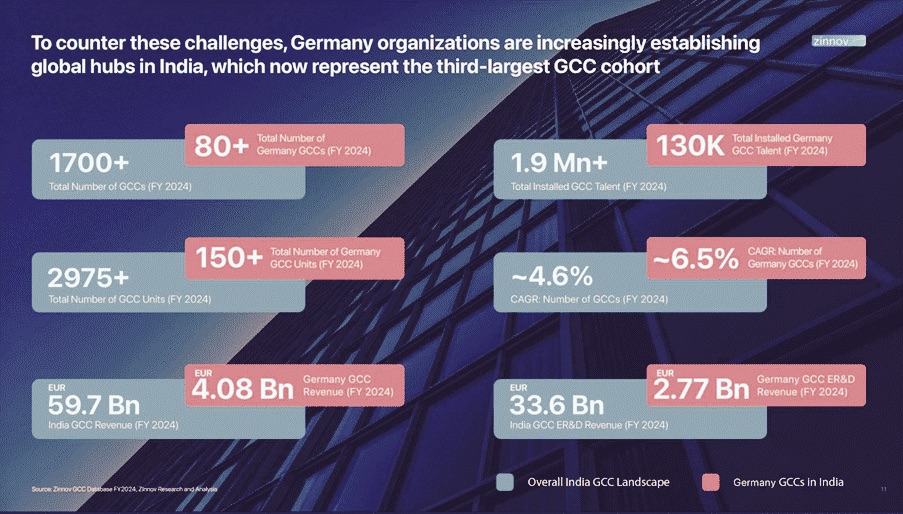
India is the Global Capability Center (GCC) capital of the world, hosting more than 50% of those hubs globally. Over 1,700 GCCs exist in India, with many companies running more than just one unit.
The main reasons why companies set up GCCs in India are
- Access a vast pool of engineering talent
- Tap into India’s rapidly growing economy
- Create international synergies and foster partnerships in the local ecosystem (academia + start-ups)
Cost arbitrage remains an additional advantage, but has not been a priority for many years. GCCs are transforming increasingly into key centres of innovation, especially in cutting-edge technology such as AI, ML, or cybersecurity.
How are German companies positioned?
German GCCs are India-based technology service hubs of companies headquartered in Germany. These dedicated innovation hubs are owned and operated by the companies themselves, enabling them to drive internal developments end-to-end with global impact.
The data reveals that German GCCs are generating above-market value from their India operations:
- Growth rate: The number of German GCCs is expanding at 6.5% compared to the market average of 4.6%, indicating that German businesses are increasingly recognizing the strategic value of establishing hubs in India..
- Revenue: German GCCs generate EUR 4.08 billion, representing 6.9% of total GCC revenue in India (EUR 59.7 billion). This is noteworthy given that German companies account for less than 5% of all GCCs (80+ out of 1,700+), suggesting strong revenue quality per hub and high quality contribution to R&D.
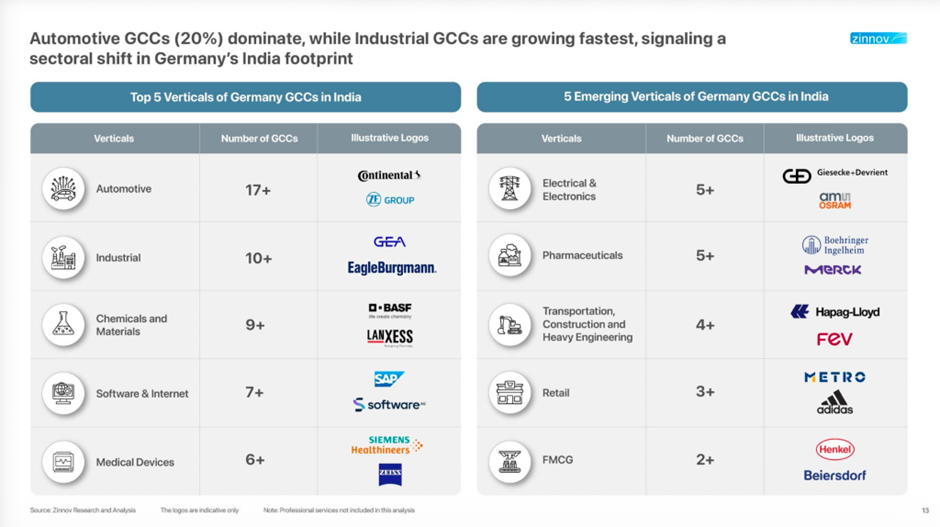
German companies established their first GCCs in India three decades ago and now form the third-largest cohort globally, after the US and UK. While the automotive, industrial, and chemicals sectors, along with large multinationals, continue to dominate, Germany’s Mittelstand is substantially expanding its GCC presence and represents approximately one-third of all German GCCs in India as they grew over 108% in the past 5 years. As example, Zeiss opened its GCC in 2024 and targeted to scale headcount to 600 employees within a short timeframe.
GCCs enable German businesses to address their current challenges through three key mechanisms:
- Accelerating adoption of technological developments
- Deploying their substantial operational expertise in a new market at manageable costs
- Preserving their distinctive culture and intellectual property through the in-house nature of GCC operations
It is therefore important to highlight that these centers help in accelerating technological development and drive innovation. SAP runs its largest center outside of Germany in India, Siemens Healthineers’ largest campus worldwide is currently under construction in Bengaluru for those exact reasons.
What are recent trends?
Noticeable trends are related to regional positioning as well as functional importance within global organisations.
Eastern Europe has traditionally served as a strategic location for smaller GCC operations, but multinational corporations are increasingly relocating their functions to India or consolidating their operations there entirely due to the availability of talent and to some extent cost arbitrage. Deutsche Bank for example decided to move its risk modelling team to India, and SAP is increasing its AI ERP system engineering team in Bengaluru.
Technological depth and maturity of the centers is another trend and helps GCCs, whether with deep R&D capabilities or with separately functioning AI Center of Excellence, to stay on top of technological developments.
Conclusion
India’s GCC ecosystem is booming and an integral part of India’s technology ecosystem. While many German businesses still rely on outsourcing partners such as Tata, Wipro, Capgemini or Infosys, a growing number of companies seek the advantages of increasing control inhouse and choose to establish GCCs. A trend with substantial economic impact, as GCCs for example accounted for 40% of office demand in 2025.
If you are interested in more details about the GCC landscape, then you can check out the ongoing India Rising Perspective by Zinnov.
Disclosure: I am part of Zinnov’s advisory board. Zinnov is a key enabler for GCCs in India according to neutral market intelligence and has helped establish more than 200 GCCs including for many German companies.
Sources: Zinnov report “Germany’s India Advantage – Leveraging India Hubs for Innovation and Growth” in collaboration with Indo-German Chamber of Commerce, nasscom, Moneycontrol
Further information: India Rising
Editor’s note: Peter Paul Pratter is a business and real estate strategist and expert, founder of the „India Rising“ platform and since 2026 a columnist for theinder.net (press release – in German).


Tariffs can fall overnight, but industrial positioning takes decades. Europe’s automotive industry now faces the real test: committing to India, not merely exporting to it.