
There is a certain historical irony in the fact that the man who once mocked his Indian counterpart as a „tariff king“ has now become the reluctant midwife of a newly sealed free trade zone between Europe and India. A commentary by Bijon Chatterji.
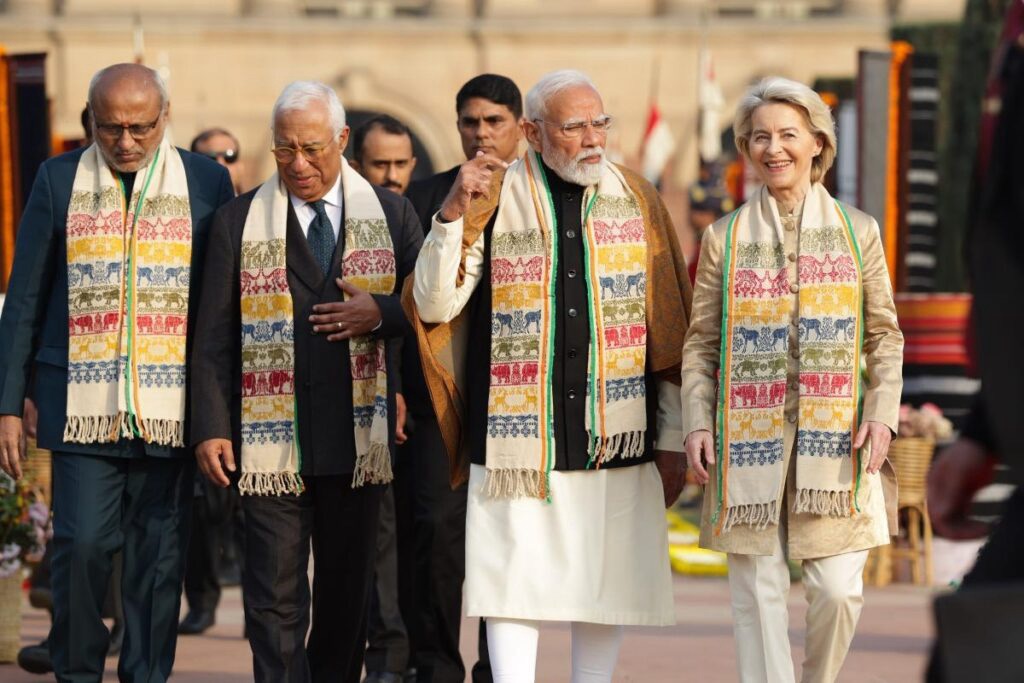
When Ursula von der Leyen and Narendra Modi stood side by side in New Delhi to announce the conclusion of the EU–India Free Trade Agreement, they were not merely celebrating a diplomatic breakthrough. They were acknowledging a deeper shift in the global order. This deal is the product of a new geopolitical logic shaped by a Washington that treats tariffs as tools of punishment, and a Moscow whose appeal as a partner increasingly ends at pipelines and ports.
India’s quiet emancipation
For India, 27 January 2026 marks a subtle but decisive turning point. The much-invoked mantra of „strategic autonomy“ – long more rhetorical than real – is now underpinned by something concrete: privileged access to a European market of 450 million consumers. India is signalling that its careful balancing act between rival blocs is not indecision, but design… a way of preserving freedom of action in a world of narrowing choices.
The timing is no coincidence. With the United States under Donald Trump slapping 50 per cent tariffs on Indian textile exports, Brussels suddenly became a far more attractive negotiating table. This is not India running into Europe’s embrace. It is a calculated act of hedging: diversification as statecraft.
Healthcare and AI: where the deal really matters
Strip away the headlines about machinery and automobiles – tariffs falling from a punitive 110 per cent to a still hefty 40 per cent – and the real significance of the agreement lies elsewhere. The heart of the deal beats in healthcare and digital governance.
India is no longer content to serve as the world’s low-cost pharmacy. By aligning clinical standards and strengthening intellectual property protections, the agreement positions the country as a serious research and development partner for Europe’s biotech industry. The subcontinent is being recast not as a supplier, but as a co-creator.
Artificial intelligence reveals an even bolder ambition. Here, the EU and India are attempting what neither Washington nor Beijing seems willing to try: restraint. Between America’s laissez-faire tech capitalism and China’s architecture of digital surveillance, Brussels and New Delhi are sketching a „third way“ – ethical AI, anchored in accountability, transparency and public trust. It is an uneasy experiment, built on Europe’s regulatory muscle and India’s vast data reserves. But it may yet define the rules of the game.
Realpolitik, without illusions
Predictably, criticism has come from Washington, where voices accuse Europe of „rewarding“ India despite its continued energy trade with Russia. I am afraid, the charge misses the point. Pressure politics have rarely worked in New Delhi; they tend to harden resolve rather than bend it. Europe’s strategy is more pragmatic: recognise India as what it is becoming – the world’s third-largest economy – and bind it through interdependence, not coercion.
That said, illusions would be misplaced. India’s bureaucracy remains a formidable obstacle, particularly for small and medium-sized European firms. And the exclusion of politically sensitive sectors such as dairy farming may have eased negotiations, but it also caps the agreement’s transformative potential.
For consumers, the promise is more immediate: greater stability in uncertain times – from access to affordable medicines to more resilient digital supply chains. In the end, this agreement is neither a triumph of free-market ideology nor a surrender to corporate power. It is a tool of self-preservation in an increasingly fragmented world.
Call it what it is: hard-headed realpolitik – adapted for an age of blocs.