
Europe is investing billions in AI sovereignty and digital infrastructure. Yet it’s overlooking a partnership that could accelerate both: India. Stanford’s latest AI Vibrancy Index ranks India third globally in AI, outperforming all European nations. While global businesses establish AI Centers of Excellence across India, European representation remains surprisingly limited. Peter Paul Pratter explores this imbalance in his new column India Rising – Der Wirtschaftsblick, published exclusively on theinder.net.
Europe’s perception of India’s role in technology is outdated
“Outsourcing? Call center? Back-office services?” Whenever I initiate conversations about India and its role in technological development, I’m regularly confronted with such outdated views and misconceptions. These times are long gone and service centers have been replaced by highly mature technology and innovation hubs focused on AI, machine learning, cybersecurity, or cloud development.
Synergies in innovation and engineering capabilities are immense and one of the reasons for technological leadership by US tech companies. While US companies have long leveraged and opened inhouse technology hubs in India, the majority of European businesses only started to take note. So called “Global Capability Centers (GCC)” –offshore entities established and operated by a business inhouse– are directly embedded in a company’s global strategy and unlike traditional outsourcing, give companies full control over their innovation pipeline while tapping into India’s ecosystem. Yet while over 1,700 GCCs now operate in India, European representation remains disproportionately small. German engineering firms and French industrial leaders are underrepresented in a market that could solve their AI and technology talent shortages and provide access to a leading technology ecosystem.
India is outperforming Europe and amongst the top 3 in AI
India ranks third in Stanford’s AI Vibrancy Index, outperforming Germany, France, and the UK. More telling: India leads in the exact areas where Europe struggles: R&D output and talent availability.
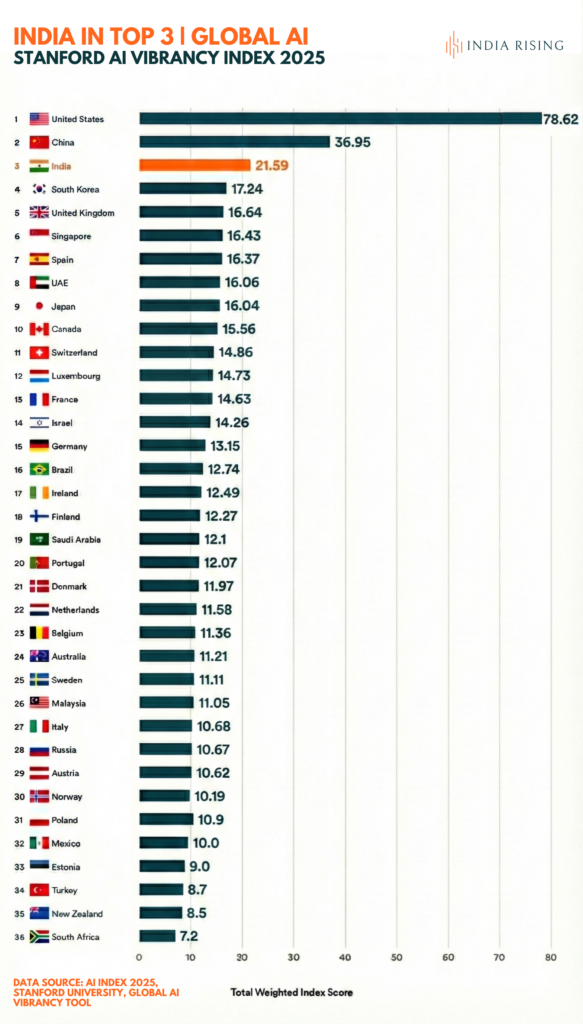
AI development is accelerating globally and influenced by a range of factors. Stanford University’s Global AI Vibrancy Tool combines and transparently evaluates 39 data sets such as user preferences, policy decisions, or establishment of AI Centre of Excellence in order to identify global and national trends. The absolute numbers shared in the graph above are cumulated by the following measures of AI development: R&D, Responsible AI, Economy, Talent, Policy and Governance, Public Opinion, and Infrastructure.
Overall, the US is still the clear leader in AI based on the vibrancy index dataset, thanks to its strong infrastructure investments and R&D. India leads in talent availability and R&D, but struggles with an underdeveloped infrastructure. Europe on the other hand has a good talent base, but surprising weaknesses in R&D, responsible AI, and AI economy.
Big Tech’s Investments in India are the Largest Outside the US
US companies, now leaders in AI and technology, have leveraged India’s talent and technology ecosystems for over three decades. Recent announcements by Google, Microsoft, and Amazon indicate that this is entering a new phase of development: infrastructure. All three announced a combined investment of USD 67.5 billion –their largest investments outside the US– to support India’s scale, skills, and sovereignty in AI.
Market access, however, may be the real driver: Microsoft expects India to become the world’s largest software development community by 2030. Moreover, India is already home to 20% of all semiconductor designers / engineers globally.
European companies, by contrast, have made minimal comparable commitments. A strategic gap that’s becoming increasingly difficult to justify.
India and AI in 2026
Apart from the private sector developments, India’s public investments and AI strategy follow a vision built on inclusive AI. This means developing an “AI Stack” targeting accessible and local language models that represent India’s linguistic diversity, and equally important, provide an open source tech layer that allows companies to access and develop cost-efficient solutions that help uplift its broader society, improve health, and increase sustainability for all.
To address those challenges globally, India will host this year’s AI Impact Summit (February 19-20, 2026 in New Delhi) focused on “People, Planet, and Progress” after being a Co-Host of the AI Impact Summit in Paris last year. With attendance from global leaders in AI to heads of governments including France’s President Macron, the summit certainly underlines India’s role in technological innovation.
Outlook
At the AI Pre-Summit in Munich recently, India’s efforts for achieving an inclusive AI Stack based on an infrastructure and open source model layer for everyone to build on are impressive, and this inclusive and sovereign approach underlines the potential of a closer partnership between the EU and India.
The India-EU Digital Partnership provides the framework. India’s proven tech stack (payment platform UPI processes more transactions than VISA every day, biometric data platform Aadhaar is the world’s largest biometric ID system facilitating administrative processes) demonstrates what’s possible.
For Europe, the question is no longer whether India is a technology leader, but whether it can afford to remain on the sidelines while this ecosystem scales globally. Time to engage.
Further information: India Rising
Editor’s note: Peter Paul Pratter is a business and real estate strategist and expert, founder of the „India Rising“ platform and since 2026 a columnist for theinder.net (press release – in German).