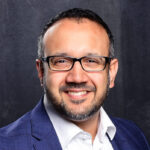
Murali Perumal (*1978) is one of the pioneers of a more diverse cultural landscape in Germany. As one of the first actors of Indian descent to establish himself in the German-speaking world, he has built an impressive career: more than 80 film roles across five countries, stage appearances at renowned theatres, and now a teaching role at the prestigious Otto Falckenberg School. His journey, however, was anything but easy. In this conversation with theinder.net, Perumal speaks candidly about stereotypes, struggles and small victories – and explains why courage, integrity, and representation are more important today than ever.
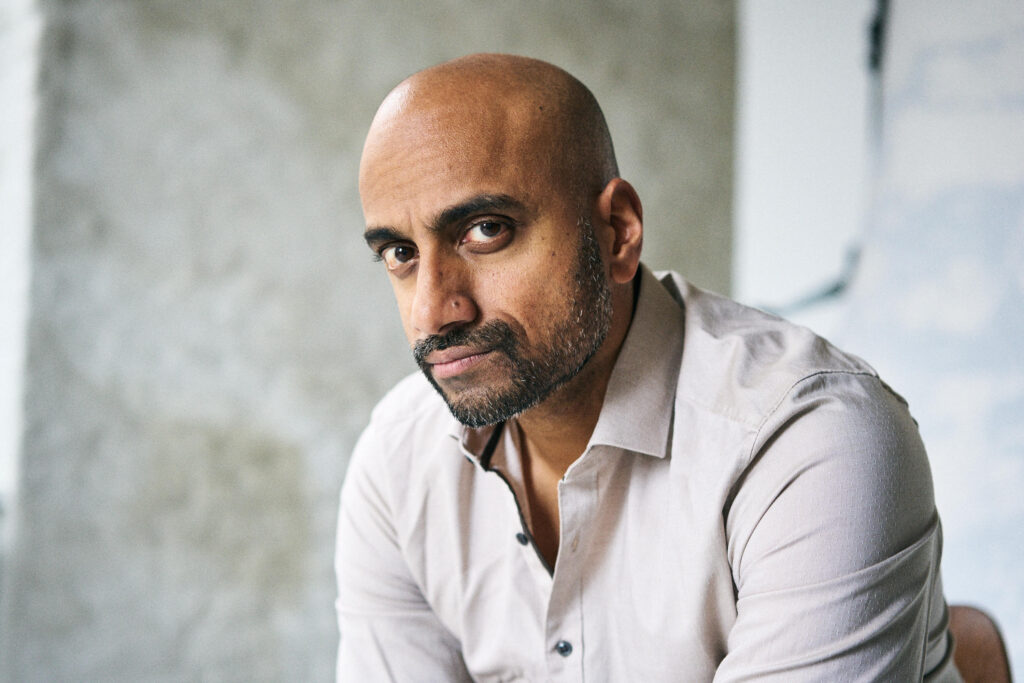
Murali, How did your journey as an actor in Germany unfold? What hurdles and opportunities did you encounter – and how did you handle the fierce competition at drama school auditions?
After finishing school in Bonn and dabbling in school and youth theatre, I was determined to get into a state drama school in the German-speaking world. The problem was the entrance exams: around 800 applicants competed for just ten places at each school. The odds were minimal.
Was there pressure from your family to choose a more „traditional“ career?
Absolutely. My parents were firmly against me studying acting. They wanted me to choose one of the classic Indian professions – computer science, engineering, economics, or medicine. I was the first German of Indian origin ever to apply to one of the major drama schools, and in fact the first Southeast Asian German to do so.
And then came the big breakthrough…
Yes. After a ten-month audition marathon, I was finally accepted at my thirteenth attempt – the Max Reinhardt Seminar in Vienna, one of the very best schools. Four years later, I graduated and began working in film, television and theatre. I have always done both in parallel – and still do. That means I have now been a professional actor for 24 years, working at large, mid-sized and smaller theatres, and appearing in 83 films from five countries.
What were your first roles like – and how did you experience them?
Back then, I was often cast in „foreigner“ roles, speaking broken German with an Indian accent – which I had copied from my parents! I also played perpetrators and victims, and only rarely characters where my skin colour or origin was irrelevant. In 2008, I became one of the first actors of colour to publicly question the dangers of stereotype casting for television and theatre audiences. I wrote articles, gave interviews in more than 27 newspapers, radio and TV outlets, and somehow became a “diversity ambassador” for theatre, film and culture – even though the term “diversity” was hardly used at the time.
Has the situation changed since then?
Only in the past three years has there been serious progress towards a more diverse acting landscape. But I am still cautious. To me, diversity often feels like a trend – more about silencing critics than about reflecting lived reality. True diversity should not need constant self-promotion. Alongside acting, I now also teach at the Otto Falckenberg School in Munich, which gives me a great deal of joy.
Have opportunities for actors with migrant backgrounds improved in quality?
For actresses of European heritage, opportunities have long been easier – the same for my Turkish-German colleagues. But genuine progress for Asian and Afro-German actors has only begun to emerge in recent years.
How have you experienced this personally?
I cannot say I have gained enormously from the diversity movement. That may be due to my age – being middle-aged now – and also because Indians in Germany form a relatively small and quiet community. Promoting diversity in film is often mistaken for simply supporting newcomers. That is a big misunderstanding: as if diversity were only for the young, while “older white Germans” are beyond persuasion. The assumption seems to be that audiences over 60 do not want to see people of colour on stage or screen. But this leaves racist prejudices and fears unchallenged. Simply relying on streaming platforms for diverse content is nowhere near enough. We also have an educational duty towards adult audiences.
So roles have become more complex and interesting?
Yes, to an extent. I was once frequently cast as the “evil terrorist”. Later, I spent years playing the “half-suspect” in TV crime dramas – the man under suspicion, interrogated, but ultimately harmless.
That sounds like progress.
(laughs) These days I get to play quintessentially German characters – a doctor, a lawyer – and at last villains again, but villains far removed from terrorism or migrant clichés. A criminal with a German name who commits a crime for human, emotional reasons – not because of ethnicity, religion, or skin colour. But even today, TV editors need convincing of this. On the theatre stage, however, things look brighter. Ensembles are becoming more diverse and are thankfully no longer exclusively white, as they were when I began.
What was it like at the start of your career?
Back then, eccentric dramaturges and directors often told me there were no roles for me in German theatre – that I was “too specific”, and “you cannot just do migrant plays”. As someone from Bonn, I could not understand it. I was only ever made into a foreigner once I entered the professional world of theatre and film. Today I am glad I overcame those obstacles and the constant naysayers, and that I am still working – despite having publicly criticised employers more than once. It could easily have backfired. But sometimes it is worth staying true to yourself and taking risks.
I like that. How important are digital spaces for identity and exchange – then and now? And what was your experience with platforms like theinder.net?
Back then, people met in person at clubs or community events, exchanged ideas, and ideally had a wonderful time together. I honestly long for those “real” encounters again. Today we spend so much time on social media. Yet social media also allows us to reach far more people, spread important messages, and network in ways that were impossible before. Theinder.net certainly played a huge role in connecting Indians and German-Indians, empowering them, and also introducing our community to many white Germans – for which I am grateful. Generally, Indians enjoy a good reputation in Germany: educated, peaceful, hardworking, successful. But I wish there were more public, critical voices from within our community – especially on exclusion, racism and broader social issues. As I said earlier, we are a quiet community.
What is needed for the next generation to engage confidently in media, art or politics? What advice do you give young people?
We need more courage – to take public positions, to criticise, to take risks, and not always try to please. Especially within our communities, we need more young people entering media, the arts and politics – areas where we are still underrepresented – and playing an active role in shaping society.
And what about integrity?
I see many successful Indians, but in public life there is still too little integrity. Particularly in these times of a resurgent far right, our voices are more urgently needed than ever. If we live quietly and comfortably, that will not protect us from growing racism. The more young people of colour work in cultural and media professions and take public positions, the more diversity will become normal in Germany. More role models will be created for migrant communities, and prejudices and fears can gradually be dismantled. We, too, actively shape society – strengthening cohesion and solidarity.
How do you see the current climate? How are media and cultural institutions reacting to the shift to the right?
I sense a backwards-looking politics that unfortunately has a strong influence on our media and cultural landscape. Diversity programmes are being cut, posts abolished. With the rise of the far right, there seems to be a desire to return to the “old white world”. Progress on representation and participation is being undone. And yes, there are clearly people who simply do not want diversity and equality. Those of us in theatre and film must not stop speaking out. The moment we grow complacent, we give hate and intolerance more room to spread.
(pauses)
Decades ago, I campaigned for a more diverse cultural landscape, but back then few decision-makers listened – I met mainly indifference. Growing up in Bonn, I experienced a naturally diverse society where people lived, learned, worked and celebrated together without constantly talking about origin or skin colour. We were simply a “we”. This model of society, which I lived for 20 years, is now unimaginable for many Germans. They see migrants or refugees only in negative contexts – crime, violence, statistics. Positive examples are missing. If people do not know “good migrants” personally and only see negative portrayals, then of course a distorted image takes hold. No wonder racism is still so widespread.
Who tells stories today – and who is being heard? What role does art play as a mirror of society and as a space to negotiate belonging, memory and the future?
We are seeing more and more young Germans with international backgrounds working as screenwriters, producers and directors. They tell our stories with an authenticity and ease we have never seen before. Their perspective is invaluable. I hope this continues, because when it comes to diversity in film and theatre – on stage, on screen and behind the scenes – we have reached only about 15 percent. We are still at the beginning. There must be no going back. Fictional stories reach the subconscious. At their best, they show a functioning diverse society where cohesion and coexistence are simply normal – in contrast to talk shows or news reports, which focus almost entirely on problems.
Finally, can you share a bizarre or funny moment from your career?
On the set of Pastewka IV, a journalist asked if I also worked as a hot dog seller in real life. On another set, someone asked if I was really a doctor. Once, when I was at the Berlinale with a film, I walked the red carpet. I was not very well-known then. The photographers glanced at me, but instead of shouting and snapping away, the silence was as deep as a Swiss forest lake. Seconds later, they began frantically taking photos in my direction. I thought, finally, they have recognised me! But then I saw a photographer waving me aside.
There was someone else behind you…
(laughs) Yes! I turned and there stood the real object of their attention: Berlin’s then mayor Klaus Wowereit. He shook my hand jovially and I said to him: “What a pity – for a moment I thought they meant me.”
Thank you for your openness and for this quite fascinating conversation.
Links: