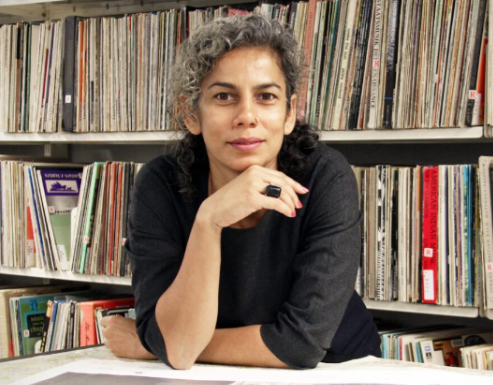
Anupama Kundoo, an internationally renowned architect and professor at the Technical University of Berlin, is one of the most influential voices of her generation. In a conversation with us, she combines research, teaching, and practice into a human-centered approach that goes beyond buildings. She sees architecture as a tool to shape the future, use resources responsibly, and nurture human potential. Kundoo describes herself as an explorer and a bridge between past and present, with a vision that embraces responsibility, awareness, and a lasting impact on society.
(Hier klicken für die deutsche Version dieses Interviews)
Professor Kundoo, to begin with, could you briefly describe yourself, your work, and what drives your architectural philosophy in your own words?
My work as an architect began directly after graduation from Sir JJ College in Bombay in 1989. Already as a student I had wondered about the prevailing construction habits of our times. What was the point of doing so efficiently things that perhaps shouldn’t have been done at all?
In the three and a half decades that followed, this questioning of basic assumptions and goals drove an architectural philosophy that was research oriented and a teaching method that was practice oriented. What emerged were theoretical principles, a practice, research findings, and a way of teaching that were interwoven to feed each other.
I look upon territory as the context: the physical, geographical, climatic and cultural context for architecture and cities to unfold. The human species has its needs from the territory in order to survive, to flourish as well as to evolve.
The place determines a lot, but the human potential to imagine, to experiment and try new things, to adapt, and to progress determine all the rest. I look at what the place has to offer, I try to look with new eyes at what exists already and what there is an abundance of. Then I try to celebrate these findings by combining them with the human skills and human genius.
Materially speaking, architecture is the rearrangement of materials/ molecules by human intervention, to that they enclose spaces and voids to shelter and facilitate human life. The materiality of architecture is particularly problematic in current times as current building habits involve unconscious and unchecked expenditure of natural resources while generating a whole lot of other imbalances ranging from pollution to the sick building syndrome. Contemporary (and often mindless) building habits threaten not only our own quality of life, health, happiness and wellbeing, but they threaten the life of other species as well as the finite natural resources that we are spending at an unprecedented pace without even necessarily being efficient.
I begin by developing an appreciation of what is already there in abundance. I look for the materials that there are in plenty and look for ways that they could be applied, I negotiate between the handmade and the machine-made opportunities, define the degree of high-tech or low-tech, and I look into the existing skills and those that could be developed locally to arrive at a building language that would produce beautiful buildings, that demonstrate human ingenuity and sensitivity, and that boost the local economy and empower the people of the place.
The relation between architecture and nature is one of co-existence. One is set in the context of the other. The non-material aspect of architecture and all the voids it contains, co-exist in continuity with the space at large. Architecture must retain that necessary porosity so that it can be intricately continuously exchanging air and breath with the environment, not unlike our very bodies and our skins. The materiality of architecture similarly also co-exists and is ideally best treated as a local matter.
The purpose of architecture is to serve as a backdrop and provide the necessary protection, and so I feel that architecture can be produced of literally anything that one finds on the spot, including ice. It is human ingenuity that must engage with the available materials to produce architecture and thus there is no need to support any fetish for materials that come from very far away, especially now that we have understood the true cost of indulging our fetishes and fleeting desires. I think of architecture as a total experience and not a mere visual or functional matter. Interest in the related fields helps me to critically view my work and where the profession is headed by staying tuned with the big picture across time and territory, and accordingly remain fully engaged in shaping the specific details of the problem at hand.
You moved from India to Germany many years ago. What motivated you to come here originally, and what do you appreciate today about living and working in Germany – especially in comparison with India, which also shaped your professional path?
I had a strong bond with Berlin ever since I had visited it in 1992 shortly after Germany’s reunification. I was particularly interested through my own roots, and our families’ intergenerational trauma of having lived through the partition of the country where our families had to be uprooted from their own homes and relocated elsewhere, never to be able to visit again what they called home. Here, in Berlin, I got to experience the reverse, and I was moved by how man-made constructs such as a divided country and a wall, could be deconstructed too! I was intrigued by its history and its capacity to keep reinventing itself according to the changing context. After 15 years of having run a research-oriented practice in India, I felt like developing a practice-oriented teaching approach for managing the current challenges and empowering the next generation. I had the opportunity around 2006 to complete a PhD under the guidance of Professor Herrle, from TU Berlin, who understood my people-centric architectural approach and completed my doctoral thesis by 2008. My interactions with the ‘cold and grey North’ were instrumental in understanding the deep impact of mainstream industrialisation on contemporary habits and mindset, and how those result in a culture of over-standardisation, based on materials that are moved across continents through extractive depletions, leading to high consumption patterns that are so normalised here. The result is not just the fact that we use standardised and modularised objects in our everyday life, but the fact that we as unique individuals may greatly underuse our unique ingenuity and creativity in uplifting our own lives and solving the problems that we face (and those that we create ourselves). I also understood the wider relevance of my own education and my upbringing and core values, where education is based on understanding the first principles, and that there needs to be space and time to ask the most inconvenient questions, to take risks and be willing to change ourselves instead of rushing about trying to influence others in order to remain in our own comfort zones.
In the early stages of your career, you worked in Auroville, where sustainability and resource-conscious architecture played a central role. What sparked your early interest in ecological and low-impact building practices, and how has this mindset evolved over time?
My interest in questioning obviously unsustainable ways of producing architecture (and many other products of daily use) began already during my early years in architecture school in Mumbai, where we were in daily touch with the growing divide between different sections of society that were accordingly impacted, and affordability and environmental degradation were growing concerns. I had attended several conferences and events discussing those concerns, already as a student. My journey from Mumbai through smaller towns and villages in India, in the effort to get a sense of overview of the matter, was what led to my eventually finding Auroville, and staying on there. Auroville was a great opportunity and a fertile ground for me to develop myself further while applying my passion, my research interests and my work as an architect, while being of service to the larger collective project. Keeping in mind the crisis that humanity finds itself in, Auroville was envisioned as a site of material and spiritual researches, with universal aspirations, committed to foundational elements that are radically rethought. For example, Auroville is a place where there is no private ownership of land. It was imagined and founded as “the city the Earth needs”. Roger Anger, Auroville’s Chief Architect, had envisioned Auroville as a compact, car-free city of the future, for a social collective life in co-housing clusters that revolved around a shared economy. That vision has only grown more relevant with time, and I continue to explore these themes in my current work, and find resonance everywhere else in the world, where these concerns are calling for new visions for a holistic reset of how humans life and need to co-exist with other humans, other life forms, and the environment that is their habitat.
As global resources are becoming increasingly scarce and expensive, your philosophy of “doing more with less” seems more relevant than ever. Why is this approach so important today – and how could it help to address pressing challenges such as the affordable housing crisis in both Germany and India?
I begin by developing an appreciation of what is already there in abundance. Even if it seems like there is nothing, in fact there is always something that exists in abundance and offers itself to be used. I look for the materials that there are in plenty and look for ways that they could be applied so that many more square meters of architecture could be built with this, I negotiate between the handmade and the machine-made opportunities, define the degree of high-tech or low-tech, and I look into the existing skills and those that could be developed locally to arrive at a building language that would produce beautiful buildings, that demonstrate human ingenuity and sensitivity, and that boost the local economy and empower the people of the place.
I do not take a nostalgic view on traditional cultural elements, because I see the human being as a creature of habits and often imprisoned in wrong habits that no longer serve us. I translate those cultural elements that are still carried in us as live values that give meaning to our lives. I believe that tradition was also ever-evolving. I also do not like to promote innovation for its own sake, as if out of boredom for the old. I like to identify genuine areas where we can do better and deserve better as thinking, aspiring and conscious beings, and then I like to express the joy and celebration of those expressions and values that we have developed over time across generations aware of the rich old civilisation that we are. I seek to produce the same timeless quality in architecture that our previous generation left behind, so that the legacy and assets we leave behind remain relevant for a long time to come, and reduce the necessity for future generation to have to over-produce in the habitat sector and conserve their surplus for more meaningful areas of human progress.
Looking at the next generation: do you feel that young people are sufficiently aware and engaged when it comes to sustainability in architecture and beyond, or is there still a need for broader awareness and education?
I teach Design Studio, and head a Chair for Architecture and Design Methods called ‘Making Matters’, where we encourage thinking with the hand, through making and experiential learnings rather than repeating the status quo prompted by our current high consumption habits. I focus on architecture’s synthesis as a coming together of non-material and material concerns, and I do this through my approach to architectural processes where research, teaching and practice simultaneously feed each other. I reveal the interrelationship and the interdependencies between space and form, and choice of materials, structural system, and construction technologies. I promote the understanding of natural laws such as gravity and climate, as distinct from man-made laws and codes. I discuss natural resources alongside human resources, and I encourage questioning of basic assumptions and codes.
As I see it, it is not teaching that is an activity but rather learning. I see teachers and students therefore on the same side. We as teachers are facilitators who create the fertile ground for enquiry and encourage curiosity. If we dwell on the questions that we don’t have answers for, sooner or later we not only find the answers, but we learn to observe the world with new eyes, and think deeply about the world as it is, in order to take the appropriate steps towards how we feel it could be instead. The design response comes out of the deep level of personal engagement in the world, instead of being ‘academic’ in the sense that the work produced there is cut-off from ground realities. So, yes I do rather see it as a nursery for developing future strategies rather than an elaboration of the past for its own sake.
Architects can inspire and innovate – but ultimately, political frameworks are needed to implement change on a larger scale. In your experience, what influence can professionals like you have on governments and policy makers, and where do you see potential for closer collaboration between countries like Germany and India to set new impulses?
Through the 30 years of my architectural practice I have produced a number of residences, housing projects and public buildings. I have developed a range of building technologies that I see as appropriate for the future in the way they bring out the beauty and strength of local materials in ways that sometimes go beyond their past applications. In the course of building buildings, I have deliberately facilitated building knowledge and building community, leaving the local people enriched at least two-fold as a bye product of having produced architecture. Off late we have been doing a number of installations where we have the opportunity to explore and exhibit more radical experimental technologies. We also have been doing many exhibitions of our work which allows us the opportunity to convey our underlying theories and methods as well as communicate the outcome through the new material and models in different scale that we are now producing. My current exhibition at the Architekturzentrum museum in Vienna is called ‘Abundance not Capital’ with an MIT Press publication of the same title. So there is already an exchange and outreach activity taking place organically, and being disseminated around.
I think that there is a great opportunity for India and Germany to produce exemplary model projects where visionary best practice projects that explore co-housing, non-ownership models, pedestrian centric mobility and high-density prototypes of co-housing clusters with shared facilities, including the integration of green infrastructure such as harvested rainwater, treated wastewater, urban farming and renewable energy as part of the intrinsic design and construction.
Early this year I was appointed to design the German Pavilion at the Kolkata Book Fair as an example of Indo-German collaboration. We had created a pavilion called ‘Shelf Life’ that was a structure built as an architecture of book shelves and daylight to read the books.
Link: Shelf Life – Anupama Kundoo
Very impressive. Lastly, what gives you hope when you think about the future – and what role would you and your team like to play in shaping it?
What remains to be known about the universe is so much more than what we do know and need to know, in order to navigate the future and ensure our own progress. In this sense I do see myself as an explorer and recognise the spirit of adventure that is associated with my work, research and teaching. I do see architecture’s potential in steer the future forward and design as a tool that helps envision better scenarios and manifest them. I believe that contrary to the notion of ‘time is money, lets cut back on human engagement’, if we invest instead in developing and spending human resources proactively, then we will automatically develop the human potential, and human skills and expertise, as well as human intelligence and engagement, care etc. We will as a consequence be more judicious in our use of natural resources and move away from the throw-away culture where things are produced and consumed mindlessly. Natural resources are finite while human resources are infinite, and the use of human resources help us to advance. What we make and how we make, in turn makes us. Architecture is society’s largest undertaking when we look at the assets that are being produced and left behind collectively. As the human species, our own consciousness is the most important area of progress, and if that remains central to all our activities, then we have this as our best tool for civic emancipation.
I see myself as a bridge between the past and the present. It is not like we want to repeat the journey of those before us, nor enslave the next generation with our influence and current ways. I feel responsible enough to not want to burn the past bridges and be aware of our role in the large, big picture view of an evolving civilisation. We want to leave behind our knowledge and our experiences and share our concerns and strategies to best navigate the issues we confront, and create the best future that we can envision.
We are grateful for the insights shared in this conversation.