
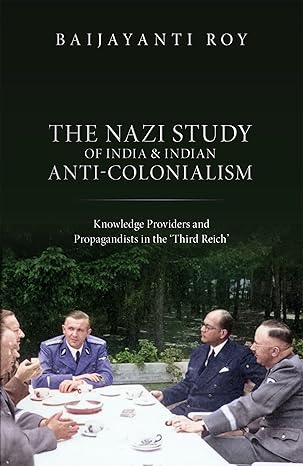
Baijayanti Roy’s „The Nazi Study of India and Indian Anti-Colonialism“ is not only a book about National Socialism. It is also a careful study of how academic knowledge can be drawn into systems of political power. Rather than focusing on ideology alone, Roy asks how expertise becomes useful, desirable, and even rewarded under an authoritarian regime.
The book shows that India occupied a meaningful place in Nazi strategic thinking. It was seen not simply as a distant cultural subject, but as a potential tool against the British Empire. Roy’s main interest, however, is not grand strategy. She looks instead at the everyday workings of knowledge: institutions, advisory roles, reports, and propaganda material. Indology appears here less as a purely humanistic discipline and more as a form of area knowledge shaped by political demand.
One of the book’s strengths is its balanced tone. Roy does not present German Indologists as fanatical Nazis, nor as powerless victims of the regime. She describes them as professionals who recognized opportunities and acted accordingly. Cooperation with state institutions often promised influence, funding, and career advancement. In this sense, the book offers a sober picture of how scholars adjusted to power without necessarily abandoning their self-image as academics.
The case studies show that the line between research and propaganda was often thin. Linguists and historians helped produce material aimed at Indian audiences, drawing on history, religion, and mythology. Yet Roy also makes clear that much of this effort failed. Nazi ideas about race and hierarchy clashed with the anti-colonial message they hoped to promote. What seemed persuasive from a German scholarly perspective often had little meaning for Indian readers or soldiers.
The book becomes particularly striking in its final chapters, which follow these scholars into the postwar period. Several of them went on to hold respected academic positions after 1945. Their earlier involvement with the Nazi state was rarely discussed and often quietly reinterpreted. Roy suggests that this silence was not accidental. It allowed the discipline to present itself as largely untouched by politics, even though its wartime entanglements told a different story.
By placing India at the center of the analysis, Roy also broadens our understanding of National Socialism. The regime’s ambitions were not limited to Europe. They extended into global spaces where knowledge, language, and cultural interpretation mattered as much as military force. This perspective gives the book relevance beyond German or South Asian history.
In the end, The Nazi Study of India raises questions that remain important today. How close can scholarship come to power before it loses its independence? What happens to compromised knowledge once political systems change? Roy does not offer simple answers, but her careful research makes these questions difficult to ignore.
Further links: