

Umeswaran Arunagirinathan (*1978) – heart surgeon, bestselling author (“Grundfarbe Deutsch”), and passionate public speaker – stands for lived resilience, humanity, and a clear stance against racism. As an unaccompanied teenager, he fled the civil war in Sri Lanka to Germany, marked by fear, loss, and the constant threat of deportation. Today, “Umes” uses his story to build bridges – between origin and arrival, between medical responsibility and social engagement. With clarity and deep empathy, he advocates for participation, linguistic integration, and an open democracy – showing that the most effective way to fight racism is dialogue.
Umes, your personal story – from humble beginnings in Sri Lanka, the loss of your sister, flight, and constant fear of deportation – is deeply moving. How did this fate shape you, and when did you first feel: “I truly believe in myself and my abilities”?
I have stumbled many times in life, and at first, it hurt a lot. Especially as a child during the civil war in Sri Lanka, I was very sad and often afraid of dying. Each time I survived the attacks and escapes from government soldiers, I became “war-grown.”
So, the civil war deeply shaped me, and looking back, it was actually good preparation for my escape across three continents. The difficult experiences during my flight were not as terrible as surviving the war itself. Every time I stumbled and managed to get back up again, I began to believe in myself and my abilities – and that remains true today as an adult German citizen.
You arrived in Germany as a 13-year-old unaccompanied refugee and lived under constant fear of deportation. How did you find the courage to keep going, and what advice would you give to young people today?
I often doubted whether I could ever overcome the fear of deportation. Once, I even stood on the 11th floor of a high-rise building, thinking about freeing myself from it all. Then I thought of my mother, who had sacrificed everything to give me a better life and who saw so much hope in me.
That is why I tell young people today: when you are struggling, think of me and my story. And I tell them, “What I have achieved, you can achieve too!”
As a heart surgeon, bestselling author, and speaker, you are active in various parts of society – medicine, literature, civic engagement. How do you reconcile these roles, and what drives you most in each of them?
I am a person who dislikes stagnation! I love movement. I often get upset about things in life, and it would be a shame if the energy this releases in me went to waste. I use that energy as a driving force to inspire our society.
Each of my books carries an impulse – a message to make our society better. Encounters and the resulting dialogue with people are what drive my actions.
That brings me to your book “Grundfarbe Deutsch.” You write that you deliberately “go where the racists are.” Which encounter or situation particularly shaped you, and why?
Dialogue is the key to combating racism. So it makes sense to go where the racists are – to build dialogue with them. It is certainly not as easy as it sounds, but I particularly remember one student from Dresden.
In the middle of a reading, he laughed out loud. I stopped and asked why.
“You are not German,” he said. I immediately understood what his problem was and asked if he himself was German. He laughed again and said, “Of course.”
“How long have you been German?” I asked. “All my life,” he answered.
Then I asked if he had ever been to Hamburg, Bremen, Cologne, Munich, Frankfurt, Kiel, Düsseldorf, Stuttgart, and so on. A quiet “No” followed.
Suddenly, silence filled the room. I said to him, “I do not understand you, my boy. I have lived in our country twice as long as you – 34 years – and I know all those cities I just named. Yet you doubt that I am a German citizen?”
In the eyes of all the students present, I saw reflection. But I did not want to stigmatize the boy. So I said: “I sincerely thank you for being brave enough to laugh out loud. You gave me the opportunity to respond not only to you but also to everyone else here in the room.”
It was important to me to try to integrate that young student despite his right-wing views. I believe that is our shared social responsibility.
You emphasize that you do not see yourself as a victim but as a fighter – for participation, language, and shared values. How do you define “Grundfarbe Deutsch” in practice, and which values matter most to you?
Grundfarbe Deutsch for me is not only the German language – it is also our Constitution, democracy, and our ethical and moral foundations, such as tolerance toward minorities.
And yes, I often get annoyed by unreliability and unpunctuality, which are frowned upon here.
In interviews, you have been critical of the fact that many immigrants isolate themselves in parallel societies and neglect language and participation. What, in your view, needs to happen at a societal level for integration to work better?
People who are integrated into our society have far better chances in everyday life and in their careers than those living in parallel societies. Many people who come here are afraid they will lose their own culture if they anchor themselves firmly in our society. But that is not true – one’s original culture is part of one’s personal identity.
Those affected must want to integrate, and we must give them the opportunities to do so. I believe that everyone who comes to us should be allowed to work – but also has to finance themselves, with individual exceptions. Work and professional life foster integration best – and the same is true for education.
Our names have something in common – both are hard to pronounce in Germany (both laugh). I once read that you told your patients: “My name is Dr. Umeswaran Arunagirinathan. But please just call me Dr. Umes…”
At school, I was not gifted with language, and even today I still find it difficult to pronounce, for example, Eastern European names. So how could I expect an 80-year-old patient, meeting me for the first time, to pronounce U-mes-wa-ran A-ru-na-gi-ri-na-than correctly?
I take it all with a certain serenity.
That would certainly do us all some good – thank you.
Buchtipp: „Grundfarbe Deutsch“
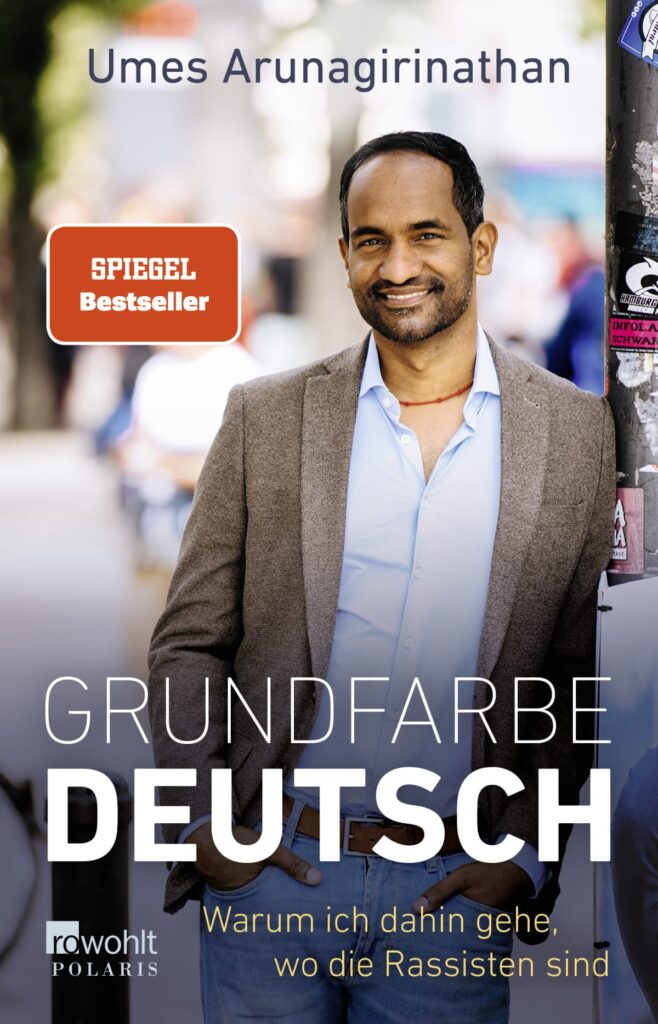
Inhalt: Dr. Umes ist Herzchirurg, erfolgreicher Autor, engagiertes Mitglied der deutschen Gesellschaft – und dunkelhäutig. Wie viele andere farbige Menschen erlebt er immer wieder diskriminierendes Verhalten seiner Umwelt. Mal ist es nur eine dumme Bemerkung, mal ein gravierender Verstoß gegen seine Würde als Mensch. Gleichzeitig gibt es eine Debatte darüber, was man «eigentlich noch sagen darf», ohne in die rechte Ecke gestellt zu werden. Umes klagt nicht an, sondern klärt auf. Anhand seiner Biografie beschreibt er pointiert, mit welchen Schwierigkeiten farbige Menschen zu kämpfen haben. Doch er sieht sich nicht als Opfer, sondern als Streiter für ein Zusammenleben, in dem das Gemeinsame die Hauptrolle spielt: die Grundfarbe Deutsch eben. Dazu gehören die deutsche Sprache, die Freiheit zur Selbstentfaltung, Gleichberechtigung und einiges mehr. Es ist das, was diese Gesellschaft für die Deutschen aller Hautfarben ausmacht. Wir dürfen nicht zulassen, dass der Rassismus diese Werte zerstört.
„Grundfarbe Deutsch“ von Umes Arunagirinathan, rowohlt Verlag