
(Hier klicken für deutsche Originalfassung)
Mithu Sanyal, born in 1971 in Düsseldorf, is a cultural scholar, novelist, and journalist. With wit, acuity, and a flair for the unexpected, she explores in her work – shaped by her part-Indian heritage – the intricate entanglements of identity, colonialism, racism, gender, and power. In this conversation, she speaks about fluid identities in pre-colonial India, the modern tendency to focus on the most dysfunctional aspects of public debate, and why “white” and “black” are social constructs. She explains the advantages of being “brown with a PhD,” how language makes social transformation imaginable in the first place, why Hindu nationalism emerged as a response to British colonialism – and gives us a glimpse of her next novel.
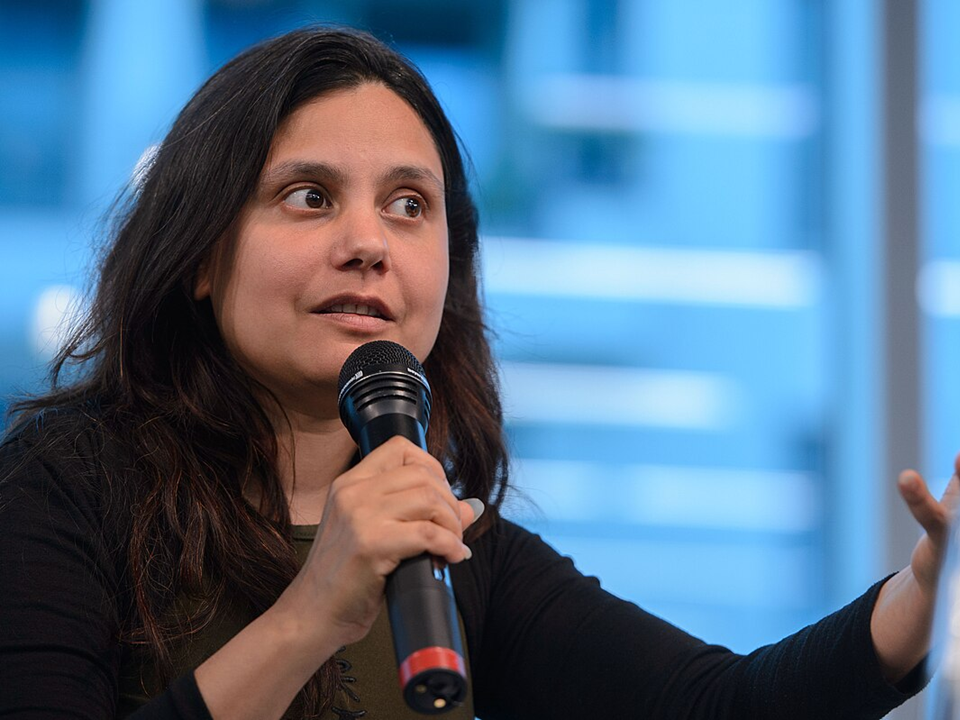
Mithu Sanyal, the question of identity has long been explored in multifaceted ways within Indian thought. In Buddhist philosophy, the saying sabbe dhammā anattā teaches that “all things are without self” – that is, without a fixed identity. In Amir Khusro’s famous Sufi poem Chhāp Tilak, the encounter with the divine is portrayed as a moment of liberating self-dissolution. And in Advaita Vedānta, the division of the world into separate identities is itself considered an illusion. In the modern West, by contrast, identity is treated as something to be found, cultivated, and defended. Who, then, is right?
Of course, I side with the traditional Indian understanding of identity. That’s precisely the problem with the West – it has managed to export its own concepts of identity so successfully. In my novel Antichristie, I explore, among other things, how religious identity in India, as we understand it today, did not exist until the British arrived and codified it in 1858, following the first Indian War of Independence. Before that, people could be Hindus and Muslims at the same time – and it wasn’t a problem at all. To say, “I am a Hindu and a Catholic,” was not considered a contradiction. But the British were very invested in dividing Hindus and Muslims. To do so, they first had to convince people that they possessed mutually exclusive identities, identities that stood in absolute opposition to one another. That’s why, in 1858 – the year after the uprising – the first census was conducted, forcing people to tick a box: Hindu or Muslim.
In your books Identitti and Antichristie, you approach the subject of identity playfully—at times tragically, but always with humour. Should we be taking our identities a little less seriously?
I love the philosopher Kwame Anthony Appiah, who wrote a book called The Lies That Bind: Rethinking Identity. In German, it’s simply titled Identitäten, but the more accurate translation would be that identities are necessary lies.
It’s clear that human beings need to classify – to make sense of other people, and of the world around them. So identities do matter, but not in the rigid, exclusionary way we tend to treat them today. And obviously, when we say things like “I don’t see identities” or “identities don’t exist,” they don’t actually dissolve – the status quo merely remains intact.
That means that in order to subvert identities – or to draw attention to the discrimination we experience because of them (as Kwame Anthony Appiah points out, identities determine less what we do than what is done to us) – we have to name those identities, thereby, in a sense, reinforcing them. It’s a paradox we can’t quite escape.
That’s why I always advocate for making identities as flexible, as porous, as possible. But at the stage we’re in now, we’re not going to step outside the game entirely.
What does “cultural appropriation” actually mean?
Why is it considered problematic when white people practise yoga, yet entirely unproblematic when Indian people put on a suit and head to the office in the morning – or engage in other habits that originate from “white” culture?
It really begins with the term itself. The problem lies in the word “cultural.” What do we actually mean by cultures? Cultures have never been sealed entities – they have always intertwined, borrowed, and influenced one another. And what about “appropriation”? When does taking become stealing? What, then, would be the opposite – cultural appreciation? These are, of course, immensely complicated questions.
The reason I found the debate about cultural appropriation misguided and yet not entirely unproductive was that, for a very long time, whiteness functioned as the unmarked norm. The assumption was that white people could do anything – play any role, speak for everyone – while racialised or otherwise marked people were only ever allowed to speak for themselves. The discussion around cultural appropriation actually drew attention to this structural hierarchy.
Interestingly, the term wasn’t originally “cultural appropriation” at all, but “cultural colonialism,” coined in the 1970s. It referred to cases where Europeans went to other countries and took out patents on plants or medicines that local communities had used for centuries – and suddenly those communities were no longer allowed to use their own knowledge, because it had been commercialised and copyrighted elsewhere.
These are crucial issues. Yet when we look at the debate in Germany, we tend to focus on its most dysfunctional aspects – for instance, when people say: “Yoga is cultural appropriation.” That’s where things get tricky. Who, after all, owns yoga? At the same time, it’s true that there are many dubious or exploitative forms of cultural borrowing – and it would be healthy for us to reflect on how to engage respectfully with traditions and practices we weren’t raised in. The problem is, we simply don’t have a framework for that.
There’s also the economic dimension: who profits? The classic example is Elvis Presley, who drew heavily from Black musical traditions – which was wonderful and transformative – but he made the money, while the people who shaped his sound remained largely uncredited and unpaid.
So within a capitalist system, cultural appropriation is also about who gets compensated, and who doesn’t; who receives recognition, and who remains invisible. Often, then, the question isn’t who is allowed to do something, but rather how we can properly acknowledge where things come from – how we can distribute resources more fairly, give credit where it’s due, and assign authorship and ownership transparently and justly.
And very often, the real question is not who should or shouldn’t be allowed to do something, but rather that we should acknowledge where things come from – that we must distribute resources fairly, give proper credit, and ensure that copyright is assigned clearly and justly.
Is “white” more of a cultural algorithm than a skin colour?
And are brown people who grew up among white Germans, in that sense, themselves “white”?
(Smiles) That’s a good question. “white”, of course, is no more a skin colour than “black” or “brown.” These are all social constructs.
The idea that “black” is socially constructed has long been unpacked by activists – which is why we usually capitalise the word “Black,” to signal that it refers to a social construct rather than to literal skin colour. After all, many people considered “black” do not, in fact, have black skin – there’s enormous variation. What the term indicates is a social position, a marker of how people are perceived and treated. And the same is true of “white” – “white” is equally a constructed category.
For a very long time, people did not define themselves by skin colour. They certainly distinguished themselves from others, but along lines of land, language, or religion.
“White” as a race was invented in order to invent “black” as a race – to justify the transatlantic slave trade, to claim it was acceptable to exploit, oppress, and “enslave” human beings, even though, of course, no one can be a slave by nature.
The invention of “blackness” thus required the parallel invention of “whiteness.” Yet over time, whiteness became invisible, precisely because white was treated as the norm.
As a result, activists and scholars have long worked to expose blackness as a social construct – to say, “Wait! This is not biological, it’s constructed!” – but they have not, at least not to the same extent, done the same with whiteness.
I’m also a brown person who grew up among white Germans, and I now use “Brown” as a political term. It’s not as though we are somehow “white on the inside.” White, Black, and Brown – or PoC – are all, fundamentally, matters of social positioning.
In Germany, I was never perceived as German, but always as “not quite German.” Marked by questions like “Where are you from?”, which really meant, “Why are you brown?” And yet, of course, I’m German in countless ways. I notice it most when I’m in London, walking down the street and constantly thinking: “When exactly is the next bin coming up? Why don’t they have proper rubbish bins here?”
But whiteness is not something internal; it’s a social position – one that, because of my skin colour, features, and name, I simply don’t have access to.
At the same time, there are, of course, vast differences within both brownness and blackness. Brown is not simply brown. Being brown with a PhD, as I am now, almost cancels out the brownness itself – at least when you’re looking for a flat.
Language is never “truth,” nor can it fully express it.
To what extent can the use of different or newly coined terms – or the transfer of existing words into new contexts – allow us to see the world differently, or make the invisible visible?
Two things. On the one hand, whatever we lack language for becomes very hard for us to imagine. I wouldn’t say it’s entirely unimaginable, but it is difficult to grasp. And, on the other hand, it makes it harder to communicate with others about it. In that sense, language also helps to produce truth – that is, what we perceive as shared reality.
For example: when I was born, the official term for people like me was “foreigner.” Yet of course I wasn’t a foreigner – I was born here in Germany. Still, people who were, in fact, German were labelled as foreigners. I didn’t have a German passport either, because at the time the law stated that children inherited the nationality of their father, not that of their mother.
Language, in that sense, is one way of structuring reality. Of course, it wouldn’t have been enough simply to find different words. But using different language to make new things imaginable was part of the political struggle. My mother, for instance, was active in the Interessengemeinschaft der mit Ausländern verheirateten Frauen (iaf) (Association of Women Married to Foreign Nationals), campaigning for German women to be able to pass on their German citizenship to their children.
They won that fight in 1975. And I still remember — it’s truly my very first memory — having that German passport, and sensing my mother’s immense relief. In 1975 I was three years old and had no idea what “German” meant, what a passport was, or what citizenship even meant. But I could feel my mother’s overwhelming sense of relief.
Of course, all of this was based on racist assumptions. These women were told: if you marry these men, your marriages will fall apart anyway — and afterwards they’ll take your children back to their home countries, and you’ll never see them again.
That’s why, for my mother and the other women who fought this political battle — sometimes driven by the wrong political motivations, perhaps, but still a real struggle — it was an enormous relief finally to have a legal right to their own children.
At the same time, I also believe that we often overestimate the role of media language in our political struggles. In recent years I’ve been asked about language politics constantly, and I do think it’s important – but it’s not, in truth, the very first priority. Once political circumstances change, language usually changes automatically as well.
But there are, for example, cases like the former GDR, where there was far greater equality and women had far more rights than those in the West. Yet after reunification, the feminists from the East would say, “Ich bin Ingenieur” (“I am an engineer” — using the grammatically masculine form, which in German can be generic), and the West German feminists would reply, “You’re not using the feminine form — that’s not feminist. You have to say: ‘Ich bin Ingenieurin’ (‘I am a female engineer’).”
(Editor’s note: The irony, of course, is that the East German women were engineers — but in German, the masculine form had been used as the default, and only later did gendered language itself become a political battleground.)
That shows, of course, that language isn’t everything. But language politics is not a culture war, nor is it “woke” or absurd – it’s part of our effort to name things accurately, and to reveal how people are assigned their place within the social order through the very act of naming.
Your latest book, Antichristie, was published in 2024. It also deals with Vinayak Damodar Savarkar, regarded as the ideological founder of Hindu nationalism – whose intellectual heirs are now in power in India. Is Hindu nationalism, then, a desperate attempt by Western-educated Indians to resolve their inner conflict between Western humanism and Enlightenment thought on the one hand, and Indian tradition on the other by imitating the Western concept of the “nation” and inventing a new sense of “Indianness”?
I have a real problem with ethnonationalism, and that’s precisely why I wanted to engage with Savarkar – and with the roots of Hindu nationalism. How did it even come about in the first place?
Hindu nationalism, of course, emerged as a reaction to colonialism. Hindutva is the ideology that Savarkar didn’t invent but effectively came to embody. Even the term Hindutva itself doesn’t originate with him, yet it has become inseparably linked to his name because of his book Hindutva: Who Is a Hindu? – which is often described as the “Bible” of Hindu nationalism.
For him, it was both about defining who counted as Hindu and about resistance – primarily against the British colonial rulers, and, in its historical form, secondly against Muslims.
Most anti-colonial movements understood themselves as national movements, because they were fighting against nation-states and therefore had to define themselves as nations in order to say: We too are a nation; we therefore deserve our own state – and that state, in turn, should be a nation-state.
That’s why I’ve always been deeply impressed by thinkers like Rabindranath Tagore, who said, essentially: Stop! Nationalism and nations are already a dead end – if we follow the idea of the nation to its logical conclusion, genocide is already contained within it. There’s that wonderful line from Tagore, who remarked that there is no word for “nation” in his language (Editor’s note: “We have no word for Nation in our language. When we borrow this word from other people, it never fits us.” – Rabindranath Tagore). And that, really, is the kind of political and philosophical framework I want to work with.
But while writing the book, I came to understand much more clearly how Hindu nationalism emerged quite directly from specific reactions to specific political circumstances. And then, of course, a great deal of trauma was layered on top of that – creating a very toxic cocktail indeed.
Alarmingly, what the Modi government understands by Hindutva and what Savarkar himself meant by it are two very different concepts. Once again, the most dysfunctional, exclusionary, and disturbing elements have been selectively taken up. The fact that Savarkar was vehemently opposed to the caste system is ignored. The fact that he was an atheist – a Hindu atheist, but still an atheist – is ignored. And the fact that he advocated intermarriage between Hindus and Muslims is ignored as well.
When I look at Savarkar, I see a great deal of admiration for Muslims in his thought. His idea of Hindutva actually emerged from a desire for Hindus to become more like Muslims. He didn’t want to destroy Muslims; rather, he wanted to “absorb” them – to turn them into Hindus through intermarriage. That, of course, is horrifying in its totalitarian logic, and it is indeed fascist – but not in quite the same way that it is being enacted in India today.
What ideas do you have for your next book?
I’ve actually just been speaking with my editor. I’ve sent him the outline for my next book, and I’m really looking forward to starting the writing process. The novel will again explore the experience of having parents who come from another country — or, more symbolically, from another element.
The mother of one of my main characters has drowned, and the daughter is convinced that her mother was a selkie — a mythological creature from Celtic folklore. Selkies are seals that can come ashore, shed their skins, and live as humans, before returning to the sea and becoming seals again. In these myths, the mothers always eventually leave their families to return to the sea. My protagonist is certain that her mother was one of them — which becomes a way of grappling with the fact that she can’t fully understand her mother’s life: not only because she didn’t share it, but because her mother is gone — and because she came from another country.
That’s one strand of the story. The other deals with the question of what we are allowed to collect. What are we permitted to display in our museums? What about unquiet objects — things we shouldn’t collect at all, which then take on a kind of ghostly life of their own? And what about the myths and fairy tales we do collect, but do so in such a — let’s say — nationalistic way? Take “German fairy tales,” for instance: in truth, they are far more hybrid, drawing on a wide range of geographical and cultural sources.
It’s also about the stories we tell about ourselves — and about the devil’s pact, or rather, the many devil’s pacts. How can we write about things we’re not supposed to talk about — and if we do talk about them, how can we still write about them?
We’re looking forward to it! Thank you so much for your time — and for this conversation.