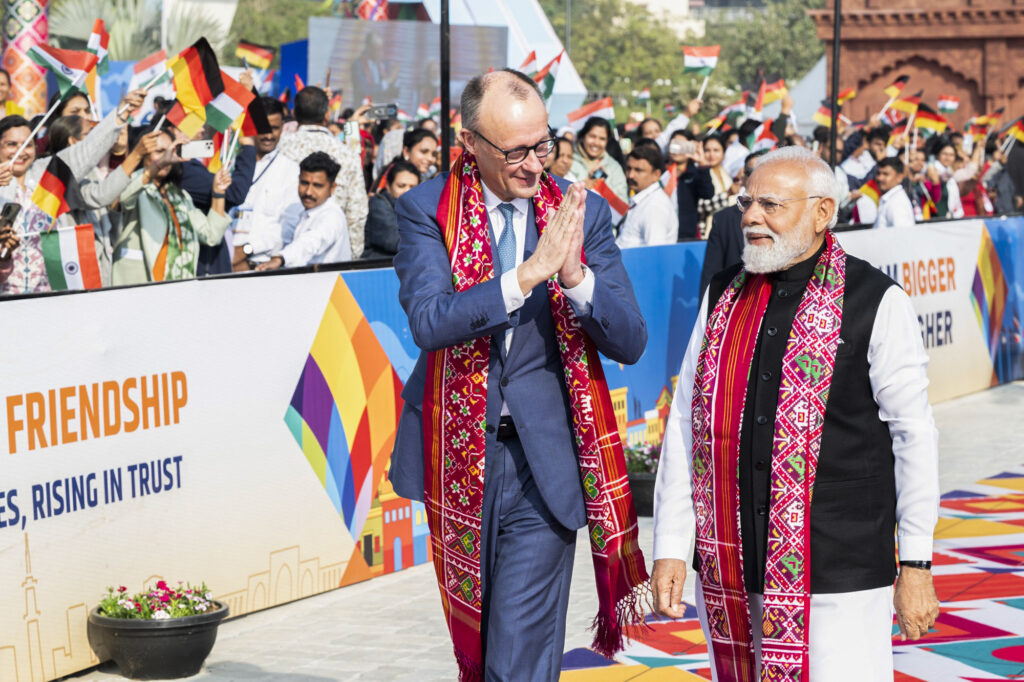
Federal Chancellor Friedrich Merz’s first official visit to India marks a watershed in bilateral relations. In Ahmedabad, the political power centre of Prime Minister Narendra Modi, a partnership was sealed that goes far beyond the scope of previous economic exchange. The joint statement serves as a programmatic guideline: while Berlin is consolidating India’s role as a strategic anchor in the Indo-Pacific, New Delhi is leveraging Germany’s technological expertise for its industrial modernisation.
Security Policy and the Defence-Industrial Pivot
A central pillar of the agreement is a strategic realignment of defence cooperation. Germany is breaking with its long-standing restraint on arms exports to South Asia and, through a “Defence Industrial Cooperation Roadmap”, is pursuing deep integration between the two defence industries. The objective is to transform a pure buyer–seller relationship into a long-term partnership focused on co-innovation and co-production. The statement explicitly highlights cooperation on conventional submarines—an USD 8 billion project is under consideration—as well as on obstacle warning systems for helicopters and counter-unmanned aircraft systems (C-UAS). Of particular significance is the formal inclusion of India as an observer in the European Eurodrone programme (MALE UAV). Through accelerated export licensing procedures and far-reaching technology transfer, Berlin is signalling its intention to anchor India as a strategic partner in the Indo-Pacific permanently to European security standards and to reduce its military dependence on Russia.
Digitalisation, Semiconductors and Innovation
Digitalisation is a core field of future cooperation and is now underpinned institutionally by a “Semiconductor Ecosystem Partnership”. The statement sets out the goal of establishing robust collaboration across the entire semiconductor value chain—from joint research and development through to safeguarding manufacturing capacities. This alliance is intended to enhance the resilience of global supply chains and reduce dependence on individual market participants. This is complemented by the “Indo-German Digital Dialogue”, whose new 2026–27 work plan prioritises Artificial Intelligence (AI), Industry 4.0, and internet and data governance. A particular success of this strategy is the opening of the Global Capability Centre (GCC) of the German chip manufacturer Infineon in India’s GIFT City, which the statement recognises as a model example of technological integration.
Start-up Ecosystems and Centres of Excellence
Both governments are devoting particular attention to the start-up sector in order to systematically promote “innovation-driven enterprises”. The statement provides for intensified exchange between the founder ecosystems in Berlin and Indian technology hubs such as Bangalore, in order to facilitate market access for young companies in both countries. A key instrument of this networking is the “Indo-German Science and Technology Centre” (IGSTC), whose mandate has been extended to further advance strategic research cooperation between industry and academia.
The newly established “Indo-German Centres of Excellence on Innovation” (IG-CoE) focus on highly relevant transformation fields: digital convergence, battery technology, green transport, and affordable healthcare. These centres are intended to ensure that academic research outcomes—such as in the fields of the bioeconomy or 3D bioprinting—are translated directly into industrial applications. Through programmes such as “WISER”, the role of women in scientific and technological innovation is also being explicitly strengthened.
Skilled Labour Mobility and Education Initiatives
For German domestic policy, the agreement on skilled labour mobility is of central strategic importance. The statement reaffirms the consistent implementation of the “Migration and Mobility Partnership Agreement” (MMPA), with a focus on managing legal migration while simultaneously combating irregular migration. The newly created “Global Skills Partnership” is designed to professionalise the recruitment of Indian skilled workers—particularly for the German healthcare sector—on the basis of ethical and sustainable standards.
A major breakthrough for passenger traffic is the introduction, announced in the statement, of a visa-free transit arrangement for Indian nationals at German airports, significantly lowering logistical barriers for travellers. In parallel, academic integration is being deepened through an “Indo-German Comprehensive Roadmap on Higher Education”, which предусматривает expanding cooperation between the Indian Institutes of Technology (IITs) and technical universities in Germany.
In order to align qualifications already in the country of origin, a “Centre of Excellence for Skilling in Renewable Energy” is to be established. This centre will develop curricula that meet both Indian and German industrial standards and will intensify the training of instructors. This is flanked by Prime Minister Modi’s call on leading German universities to open their own campus locations in India. The aim is to align training profiles in key areas such as the bioeconomy and the energy transition at an early stage with the German labour market and to accelerate the recognition of qualifications.
Energy Transition and Economic Integration
The economic interdependence of the two nations is anchored in the “Green and Sustainable Development Partnership” (GSDP). The statement underscores the progress of this flagship initiative: of Germany’s commitment of over EUR 10 billion by 2030, around EUR 5 billion has already been allocated or firmly earmarked for projects such as the “Solar Rooftop Programme” and “Water Vision 2047”. One milestone of the summit is, for example, the signing of a long-term offtake agreement between the Indian company AM Green and the German energy group Uniper. This provides for the delivery of up to 500,000 tonnes of green ammonia annually, positioning India as a central player in the future energy supply of German industry.
In addition, the statement highlights the “India-Germany Platform for Investments in Renewable Energy Worldwide”. Strengthened in October 2025 by new working groups on solar and wind manufacturing, this platform is intended to significantly accelerate technology transfer and private investment in green supply chains. The economic policy framework is also on the verge of a breakthrough: Chancellor Merz indicated that the free trade agreement between the European Union and India (FTA) could be signed as early as the end of January 2026. Such an agreement would lower tariff barriers for German exports and significantly improve market access for Indian service providers within the European single market.
Geopolitical Context and Reservations
Despite the unity proclaimed in the statement, a closer reading of the language reveals significant strategic divergences. On security issues, Berlin is accommodating New Delhi to a considerable extent: the explicit condemnation of terrorism, including specific reference to the 2025 attacks in Pahalgam (Jammu and Kashmir) and in Delhi, reads like a direct adoption of India’s security doctrine.
By contrast, the joint position on the war in Ukraine remains notably vague. While the statement emphasises the need for a “comprehensive, just and lasting peace” in accordance with the UN Charter, it avoids any explicit naming or condemnation of Russia as the aggressor. This underscores India’s continued strategic autonomy and its refusal to abandon traditionally close ties with Moscow in favour of the Western alliance.
The choice of the symbolically charged venue of Gujarat—Modi’s political home base—rather than the capital Delhi further underscores a clear prioritisation of realpolitik. While the statement invokes “shared democratic values”, critical voices from civil society organisations regarding human rights issues and religious intolerance are effectively excluded from the official communication. The document thus cements the primacy of economic and security policy considerations over value-based foreign policy concerns.
Sources:
- India – Germany Joint Statement 2026, Ministry of External Affairs India, 12.01.2026, www.mea.gov.in
- Uniper und AM Green unterzeichnen Abnahmevertrag, Uniper SE, 12.01.2026, www.uniper.energy
- Inauguration of Infineon GCC at GIFT City, CMO Gujarat, 08.01.2026, www.cmogujarat.gov.in
- Reise des Kanzlers nach Indien: Aktuelle Meldung, Bundesregierung Deutschland, 12.01.2026, www.bundesregierung.de
- Transitvisum-Regelungen für Deutschland, Auswärtiges Amt, 12.01.2026, www.auswaertiges-amt.de