
Violin maestro Dr. L. Subramaniam spoke to Herbert Lang for theinder.net about the spiritual depth of Carnatic music, his vision of Global Music, and why deep listening matters more than ever.
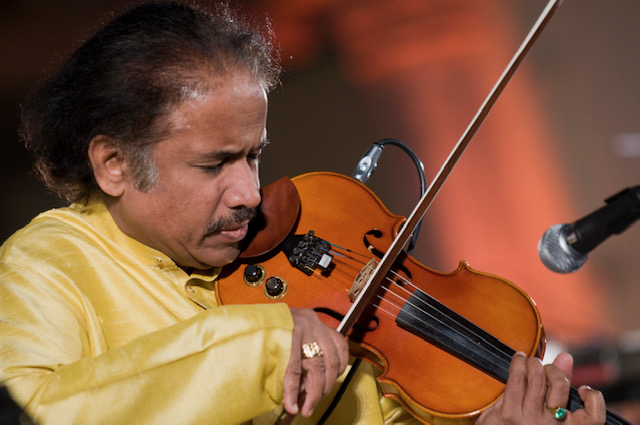
Dr. L. Subramaniam is one of the world’s foremost violin virtuosos, composers and cultural visionaries. A master of the South Indian Carnatic tradition and a trained medical doctor, he has spent more than six decades expanding the horizons of Indian classical music through international collaborations with leading artists from the worlds of classical music, jazz and beyond. Long before cultural exchange became a fashionable concept, he introduced the term Global Music to describe an artistic dialogue rooted not in the dilution of traditions, but in their mutual respect.
During a recent stay in Germany, Dr. L. Subramaniam spoke with Herbert Lang of the Deutsch-Indische Gesellschaft – himself an accomplished Carnatic musician – for theinder.net. In this wide-ranging conversation, he reflects on the remarkable parallels between medicine and music, the spiritual essence of the Carnatic tradition, the importance of cultural identity in an interconnected world, and why the art of deep listening may be one of the most powerful antidotes to the pace of modern life.
Dr. Subramaniam, you studied both medicine and music at the highest level. Do you see any similarities between the mindset of a physician and the art of musical improvisation?
There are indeed profound similarities between the study of medicine and the study of Carnatic music. Both demand discipline, precision and an unwavering commitment to excellence. In music, even when we improvise, the improvisation is never arbitrary. Every phrase must begin with precision, unfold with clarity, and conclude exactly on the intended beat or pulse. Freedom exists within a framework of absolute control.
The same principle applies to medicine. A surgeon cannot afford approximation. Every movement requires accuracy, concentration and confidence. Such confidence does not arise by chance; it is the result of years of disciplined practice, constant repetition and the gradual mastery of one’s craft. Technique is essential, but equally important is the inner assurance that comes from thorough preparation.
Beyond technical mastery, there is another dimension shared by both professions. In our tradition, we acknowledge the indispensable role of the guru—the teacher who imparts not only knowledge but also wisdom, discipline and character. Whether one studies music or medicine, the guidance of an exceptional mentor is invaluable.
My own son, Dr. Narayana Subramaniam, became one of India’s finest surgeons under the guidance of an extraordinary teacher, Professor Subramania Iyer, a pioneer in reconstructive microsurgery. He performed remarkably complex procedures, reattaching limbs severely damaged in war by reconnecting nerves, blood vessels and muscles with extraordinary precision. Such work demands the same qualities that define the highest levels of musical performance.
Carnatic music is equally intricate. Throughout my doctoral research, I explored and documented more than five million derived scalar possibilities. Yet, despite this vast body of knowledge, I remain convinced that countless musical discoveries still await us. In both medicine and music, the deeper one ventures, the more one realises how much remains unexplored.
You spoke about Global Music long before cultural fusion became mainstream. Do you think the world has moved closer to that idea today, or are we witnessing a renewed period of cultural division?
When I introduced the term Global Music in the late 1970s, it was in response to a misconception that was prevalent in the West. Western classical music was often regarded as the only „classical“ tradition, while virtually every other musical culture was grouped together under the rather indiscriminate label of world music. I never found that distinction convincing.
If we speak of world geography, we do not separate one part of the world and call the remainder simply „the world.“ Music deserves the same perspective. Every great classical tradition has evolved through centuries of refinement and deserves to be recognised on its own terms. That is why I began using the expression Global Music. From the very beginning, my intention was to build artistic bridges rather than erase cultural identities. I collaborated with distinguished Western classical musicians such as Lord Yehudi Menuhin and Jean-Pierre Rampal, and with remarkable jazz artists including Herbie Hancock, George Duke, Stanley Clarke, Jean-Luc Ponty and Stéphane Grappelli. These collaborations were never about blending traditions indiscriminately; they were about allowing each tradition to retain its integrity while engaging in a genuine musical dialogue.
India itself possesses two highly sophisticated classical systems. The older of the two is Carnatic music, whose origins can be traced back to the Vedic period. Around the twelfth century, historical and cultural developments, including the influence of the Mughal courts, contributed to the emergence of Hindustani classical music in northern India. Thus, India is home to two distinct and highly evolved classical traditions. To place both of them under the broad category of world music seemed to me an oversimplification.
I therefore advocated the concept of Global Music as an inclusive framework—one that embraces Western classical music, Carnatic music, Hindustani music and the many other distinguished musical traditions of the world without diminishing any of them.
Wherever I travelled, whether for concerts, lectures or television interviews, I consistently used the term Global Music. I also expressed this idea through my compositions, including my album Global Fusion and works such as the Global Symphony, which we premiered at Madison Square Garden during the celebrations attended by the former President of India, R. Venkataraman.
Today, the word global has become part of everyday language—not only in the arts, but also in science, business and many other fields. I take great satisfaction in seeing how naturally the concept has entered our vocabulary. I do not seek recognition for having introduced it. What matters to me is that the idea itself has flourished.
Carnatic music is often regarded as both highly complex and deeply spiritual. How do you introduce this tradition to European audiences who may not be familiar with it?
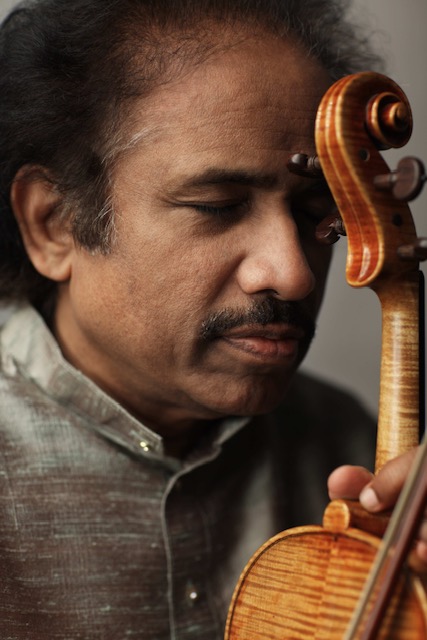
The first thing one must understand is that a raga is far more than a sequence of notes. Although every raga is built upon a particular scale, its true identity cannot be conveyed simply by playing the ascending and descending notes—what we call the ārohaņa and avarohaņa. That is merely the framework.
A raga possesses another dimension altogether. It has its own emotional character, its own personality and its own inner life. Certain notes carry greater weight than others. There are characteristic phrases, subtle microtonal inflections and delicate ornamentations that cannot be adequately expressed within the limitations of Western equal temperament. Together, these elements create an atmosphere that evokes both emotion and spirituality.
In our tradition, music and spirituality are inseparable. Most of the great Carnatic compositions were written by saint-composers as expressions of devotion, whether to Ganesha, Devi or another manifestation of the Divine. In that respect, our tradition is not unlike Western classical music. One only has to think of Bach and many other great composers whose works were likewise inspired by profound spiritual conviction.
When I perform for audiences unfamiliar with Carnatic music, I never begin by explaining its theoretical complexity. Instead, I allow the music to speak for itself. I usually open with an extended alapana, a free and unmetered musical introduction in which the raga gradually reveals its emotional landscape. The listener does not need to understand the technical structure, the intricate rhythmic calculations or the underlying theory. Those belong to the performer.
If the audience approaches the music with an open mind, they soon become immersed in its tonal colours and emotional depth. The music begins to communicate directly, beyond language and beyond intellectual analysis. At that point, the listener no longer follows the music consciously; rather, the music begins to carry the listener. One simply allows the sound to unfold, and an inner voice gently guides the experience.
You have worked with major Western orchestras as well as leading Indian classical musicians. Where do the greatest challenges arise, and where do the most rewarding creative moments emerge?
To be honest, I have rarely experienced misunderstandings in these collaborations. The essential prerequisite is mutual respect and a genuine willingness to understand one another’s musical language. Once that foundation exists, collaboration becomes an immensely rewarding process.
Working with a Western symphony orchestra naturally differs from performing with an Indian classical ensemble. An orchestra depends upon precise notation. Every note, every dynamic and every entry must be clearly written, because eighty or a hundred musicians must perform as a single musical body under the guidance of the conductor. There is little room for spontaneous alteration, and that is entirely appropriate within the Western symphonic tradition.
Indian classical music, however, rests upon a different foundation. Its defining characteristic is improvisation. In Carnatic music, improvisation is not an embellishment—it is the very heart of the tradition. That is something I have always wished to preserve whenever I write concertos or symphonic works for Western orchestras.
For that reason, every cadenza in my compositions is genuinely improvised. Although the orchestra performs from a fully notated score, the solo passages remain completely spontaneous. The conductor must therefore remain exceptionally attentive. I provide musical cues that indicate when I am approaching the conclusion of the cadenza, but its duration can never be predetermined. Sometimes it lasts a minute; sometimes considerably longer. On occasion, the energy of the audience inspires me to explore the music more extensively before returning to the orchestra.
These improvisations also allow us to introduce aspects of the Carnatic tradition that cannot easily be captured on paper: our microtonal language, intricate rhythmic structures and the dynamic interaction with percussionists such as the mridangam or tabla players. At times we also incorporate konnakol—the remarkable South Indian art of vocal percussion—which adds yet another rhythmic dimension to the performance.
This is what makes every performance unique. Even if we perform the same concerto repeatedly, no two interpretations are ever identical. The orchestral musicians faithfully realise the written score, while the solo improvisation evolves anew each time. Western musicians also shape a performance through phrasing, tempo and dynamics, but the notes themselves generally remain fixed. In Carnatic improvisation, even the melodic material is recreated in the moment.
That continual renewal gives the music a sense of freshness and discovery. I have never regarded this meeting of traditions as a challenge. On the contrary, I see it as a beautiful artistic dialogue in which both traditions retain their identity while enriching one another.
Many young people of Indian origin in Europe grow up between different cultural identities. What role can music play in helping them remain connected to their roots without limiting their openness to the wider world?
Music has a remarkable ability to unite people because, at its most fundamental level, it speaks a universal language. Across the world we may use different names, different styles and different traditions, but the basic musical material remains the same. We all work with the same seven notes.
What differs is the way those notes are shaped. Just as people in different parts of the world speak different languages, wear different clothes or cultivate different customs, musical traditions have evolved their own distinctive forms of expression. In South Indian music, for example, we use gamakas—subtle ornamentations and microtonal inflections that give each raga its unique character. Western classical music has developed its own vocabulary of vibrato, bowing techniques and phrasing. Neither approach is superior; they are simply different ways of expressing human emotion.
Our music also employs microtones that lie between the intervals of the Western equal-tempered scale. These delicate nuances cannot always be represented within a fixed tuning system, yet they contribute profoundly to the emotional richness of the music. Every tradition has its own beauty, and every tradition offers something of lasting value.
For young people growing up between cultures, this understanding is especially important. One does not have to choose between one’s heritage and the society in which one lives. A strong sense of one’s own cultural roots does not prevent openness; on the contrary, it provides the confidence to appreciate other traditions with greater depth and respect.
Music also offers something increasingly precious in today’s world: a moment of inner stillness. When we become deeply absorbed in a concert—whether it is Indian classical music, Western classical music or jazz—we forget, for a while, the everyday concerns that occupy our minds. We stop thinking about our responsibilities, our deadlines or our anxieties. Music draws us into another state of awareness.
At a time when the world is marked by conflict and division, this experience is more important than ever. Throughout my career, I have performed with musicians whose countries have been in political conflict with one another. Yet, once we begin to play, those divisions simply disappear. For the duration of the performance, we are united by a common artistic purpose, and the audience shares that experience with us.
That is why I believe music and culture play an essential role in society. They cultivate understanding, foster harmony and create conditions for peace. Beyond that, they encourage spiritual growth and self-realisation—qualities that are indispensable if humanity is to live together with greater wisdom and compassion.
Indian classical music requires patience, concentration and deep listening. In today’s fast-moving digital world, where attention spans seem to grow ever shorter, do you believe this music offers an important counterbalance?
I certainly do. If you look at the history of recorded music, you will see that listening habits have always been influenced by technology. There was a time when recordings were limited to just a few minutes on each side of a shellac record. Musicians had to compress even the most elaborate works into that format. Later came the LP, which allowed much longer performances, followed by cassettes and CDs that gave us still greater freedom. Each technological development expanded the listener’s experience.
Today, however, we are witnessing a different phenomenon. Digital platforms encourage people to move rapidly from one piece of music to another. Many listeners decide within a matter of seconds whether they will continue listening or move on. This is understandable, given the pressures of modern life, but it also carries a certain risk.
We spend so much of our lives rushing from one obligation to the next in the hope that, one day, we will finally have time to enjoy life. Yet if we allow ourselves to be consumed entirely by stress and constant activity, we may discover too late that we have sacrificed the very peace we were striving to attain. Good health, mental balance and inner contentment cannot simply be postponed until some distant future.
That is why I believe every person should make time to listen attentively to music—whatever music speaks most deeply to them. Genuine listening calms the mind, refreshes the imagination and restores a sense of inner equilibrium. Music has the extraordinary ability to awaken dimensions of our consciousness that often remain neglected in everyday life. We devote immense energy to analytical thinking, professional achievement and practical responsibilities, yet we frequently overlook the artistic and emotional aspects of our nature. Music helps restore that balance.
Learning even a little music can deepen this experience still further. It allows us to listen with greater awareness and appreciation, opening the door to an entirely different inner world. The sense of peace and fulfilment that music can bring is difficult to describe; it must be experienced.
But this requires patience. We should not listen while constantly checking the time or wondering what comes next. Instead, we should allow ourselves to become completely immersed in music. When we do, our health benefits, our thoughts become clearer, our emotional well-being improves, and ultimately our lives become richer. In that sense, deep listening is not a luxury, it is an investment in a better and more meaningful life.
If you were beginning your career today as a young musician, would you choose the same path between tradition and international collaboration, or would you do anything differently?
Looking back, I would not choose a different path. Every stage of my journey unfolded naturally, and I remain deeply grateful for the opportunities I received. If there is one principle I would emphasise to any young musician today, it is this: first become firmly rooted in your own tradition. Only then can you truly understand and engage with the traditions of others.
Without strong roots, meaningful dialogue becomes difficult. When you possess a profound understanding of your own musical language, you approach other cultures not with uncertainty, but with confidence and respect. Collaboration then becomes an exchange between equals rather than an imitation of one another.
My own musical education began with my father, Professor V. Lakshminarayana, who devoted his life to transforming the violin into a true solo instrument within the Carnatic tradition. At that time, the violin was still regarded primarily as an accompanying instrument in South Indian classical music. My father’s vision was to demonstrate that it possessed the expressive and technical possibilities of the great solo traditions of the West.
He developed an entirely new technical approach that expanded the instrument’s expressive range and opened new artistic possibilities. Inspired by the achievements of legendary violinists such as Jascha Heifetz, Yehudi Menuhin, Ruggiero Ricci and David Oistrakh, he believed that the Indian violin deserved the same international recognition as its Western counterpart.
Those foundations enabled me to pursue a path that had scarcely existed before. As I began composing concertos, symphonic works and large-scale orchestral compositions rooted in Indian classical music, orchestras and musicians around the world became interested in collaborating. At the time, there were virtually no Indian violin concertos or symphonic works of this kind. During the 1980s, I was fortunate to write major compositions for leading orchestras, and those works led to many further commissions.
I have never regretted that journey. Looking back, I can only describe it as a blessing—whether one attributes it to divine grace, the guidance of my gurus or simply the course that destiny had prepared. My father’s dream was to bring Carnatic music to the world stage, and I was privileged to continue that mission.
That journey allowed me to perform in many of the world’s great concert halls, including the Royal Albert Hall, Carnegie Hall and the Sydney Opera House. More importantly, it enabled me to introduce Carnatic music to audiences in countries where it had scarcely been heard before, including places such as Iceland and Japan.
Naturally, some people initially questioned the idea of collaborating across musical traditions. Yet those collaborations achieved exactly what I had hoped. They introduced many listeners to the tonal language of Indian classical music. Someone might first discover my music through a fusion recording such as Conversations or another collaborative project. Curiosity would then lead them to explore the classical tradition itself. Over the years, many of those listeners became devoted followers of Carnatic music, attending concerts regularly and exploring the deeper dimensions of the tradition.
That, to me, is the true value of collaboration. It should never dilute a musical heritage. On the contrary, when approached with knowledge, integrity and mutual respect, it broadens our understanding of one another and creates entirely new artistic possibilities. Ultimately, that has always been my vision of Global Music: not the blending of cultures into uniformity, but the meeting of great traditions, each retaining its own identity while enriching the others.
Dr. Subramaniam, it has been a great pleasure speaking with you. Thank you for sharing your profound insights and reflections with our readers.
It has been my pleasure. Thank you.
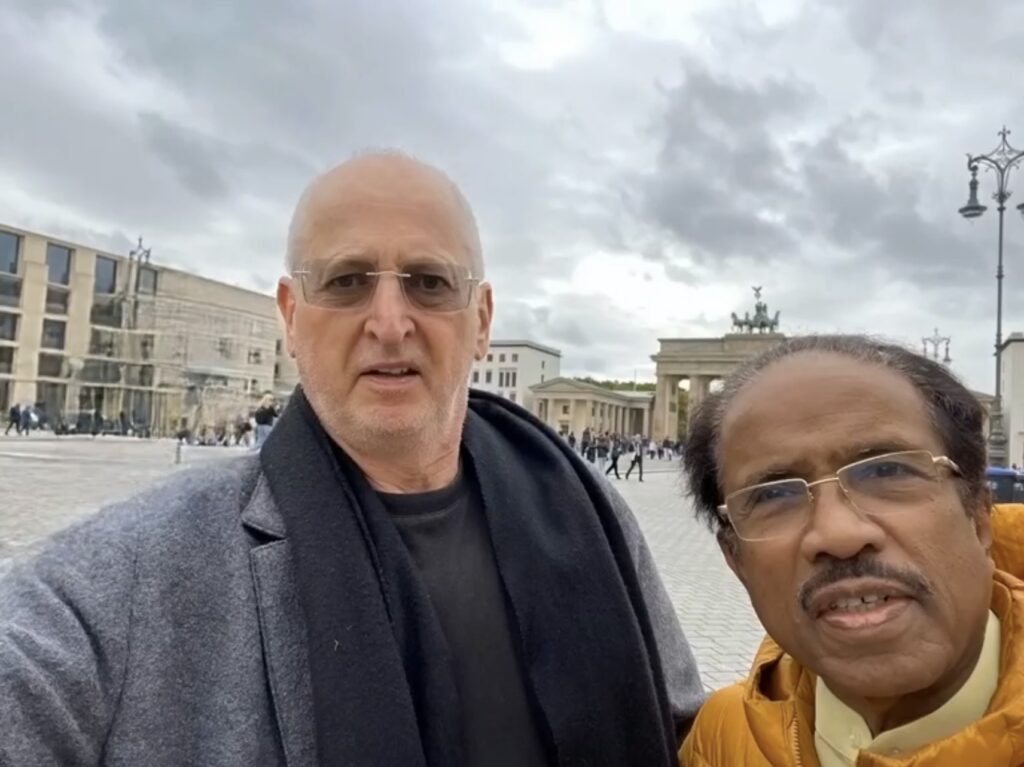
This interview was conducted by Herbert Lang from Deutsch-Indische Gesellschaft for theinder.net during Dr. L. Subramaniam’s recent stay in Germany.


Danke für diesen in der Kürze doch detaillierten Einblick in die kaneresische Musik. Ich hätte mir noch weitere Herausarbeitung der Unterschiede zwischen kaneresischer und der nordindischen Tradition gewünscht. Wenn ich es richtig verstanden habe, ist die nordindische Tradation in gewisser Weise eine Modifikation der gemeinsamen schon Jahrtausende alten auf dem Subkontinent entwickelten musikalischen Tradition durch andere (vereinfachendere?) musikalische Einflüsse. Besten Dank!