
The 2026 West Bengal Assembly election represents one of the most significant political shifts in eastern India in recent decades. For observers outside India, the result may appear surprising. West Bengal has long been regarded as a politically distinct state with a strong regional identity, a long Left political tradition, and comparatively resilient secular politics. Yet the election revealed how profoundly the political atmosphere has changed.
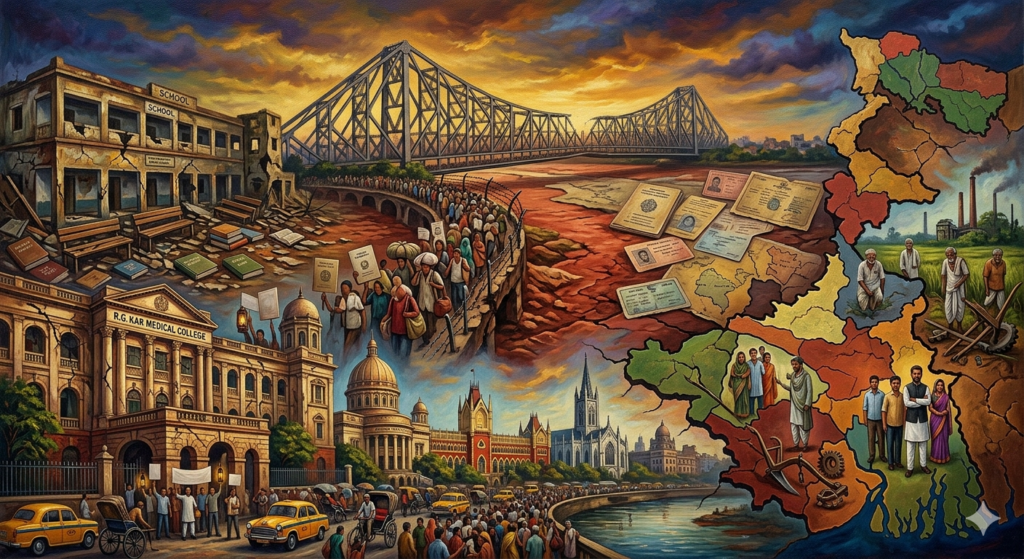
The outcome cannot be explained simply through anti-incumbency or electoral arithmetic. The election reflected the convergence of several developments: corruption scandals, administrative fatigue, welfare politics, identity mobilisation, demographic anxieties, and the growing national influence of the Bharatiya Janata Party (BJP).
Over the last several years, dissatisfaction with the ruling Trinamool Congress (TMC) steadily increased. Recruitment scandals involving school and public-sector appointments created widespread anger, particularly among educated unemployed youth. Allegations of corruption, localised extortion networks, political patronage, and declining institutional accountability weakened the moral authority of the government.
Public protests by unemployed teacher candidates became especially important because they transformed corruption from an abstract issue into a visible social crisis affecting middle-class and lower-middle-class families directly.
The public outrage surrounding the rape and murder case at R.G. Kar Medical College and Hospital further intensified public discontent. The issue generated protests across urban Bengal and strengthened perceptions of administrative breakdown, political interference, and institutional insecurity. Among many educated urban voters, the incident became symbolic of a broader crisis of governance.
Yet corruption alone did not decide the election.
As the campaign progressed, political debate increasingly shifted toward questions of citizenship, migration, border control, and demographic change. Here the BJP succeeded in reshaping the entire political discourse.
The BJP connected local dissatisfaction with a larger national narrative centred on infiltration, citizenship verification, national security, and demographic imbalance. The controversy surrounding the Special Intensive Revision (SIR) of electoral rolls became politically significant within this wider context. What was formally presented as an administrative exercise came to be viewed by many voters as part of a broader attempt to redefine political belonging and electoral legitimacy.
This proved particularly effective because the BJP was able to combine anti-corruption sentiment with emotional themes of insecurity, identity, and national protection.
At the same time, the TMC continued to retain substantial support through its welfare infrastructure. Welfare schemes targeting women, students, rural households, and economically vulnerable communities remained politically influential throughout the election. For many poorer voters, these programmes represented not only financial assistance but also social recognition and everyday security.
However, welfare politics increasingly encountered limits within an atmosphere of rising political polarisation. The TMC attempted to counter the BJP by emphasising Bengali regional identity, federal autonomy, and resistance to excessive central intervention. But by that stage, the political terrain had already shifted toward questions of citizenship and demographic anxiety.
The election also exposed the continuing weakness of the Left Front. Although Left organisations remained active in anti-corruption protests, student mobilisation, and democratic rights campaigns, they failed to regain broad electoral confidence.
One reason was generational. Older voters often continued to associate the earlier Left period with bureaucratic stagnation and political rigidity, while younger voters possessed little direct memory of the Left’s historical achievements in land reform, decentralisation, and rural mobilisation.
At the same time, the social foundations upon which Left politics once depended have themselves changed significantly. Informal employment, migration, fragmented labour conditions, digital media polarisation, and identity-based mobilisation have transformed the nature of political participation across India.
As a result, economic grievances are now increasingly interpreted through questions of identity, citizenship, religion, and cultural belonging rather than through older forms of class politics alone.
The election also revealed important changes within Muslim political behaviour in West Bengal. While many Muslim voters continued to support the TMC strategically in order to prevent BJP expansion, sections of younger voters increasingly expressed dissatisfaction with purely welfare-based representation and demanded greater political autonomy, dignity, and local accountability.
Ultimately, the 2026 West Bengal election demonstrated a broader transformation taking place within Indian democracy itself. Electoral politics is no longer shaped solely by governance or economic performance. Welfare, identity, insecurity, citizenship, regionalism, and emotional political belonging now operate together within a single political framework.
For that reason, the West Bengal election should not be understood merely as a regional power shift. It reflects a deeper restructuring of democratic politics in contemporary India.
About the author:
Dr. Sujit Narayan Chattopadhyay is a political scientist specializing in political theory, governance, and the political economy of public policy. His research offers a rigorous and critical engagement with economic policy, redistribution, and state–society relations, with a particular focus on the Indian context. He has made substantive contributions to contemporary debates on democracy, justice, and governance through theoretically grounded and empirically informed analyses. Dr. Chattopadhyay’s scholarship is distinguished by its integration of classical and modern political thought, including sustained work on Marxist theory, social contract traditions, and deliberative democracy. His research advances interdisciplinary perspectives by drawing on economics, sociology, and philosophy to illuminate the complexities of policy and governance. In addition to his research contributions, he is actively engaged in the production of advanced academic and textbook-oriented materials, particularly in political theory, aimed at strengthening higher education and scholarly discourse. His work reflects a strong commitment to analytical clarity, conceptual depth, and policy relevance.