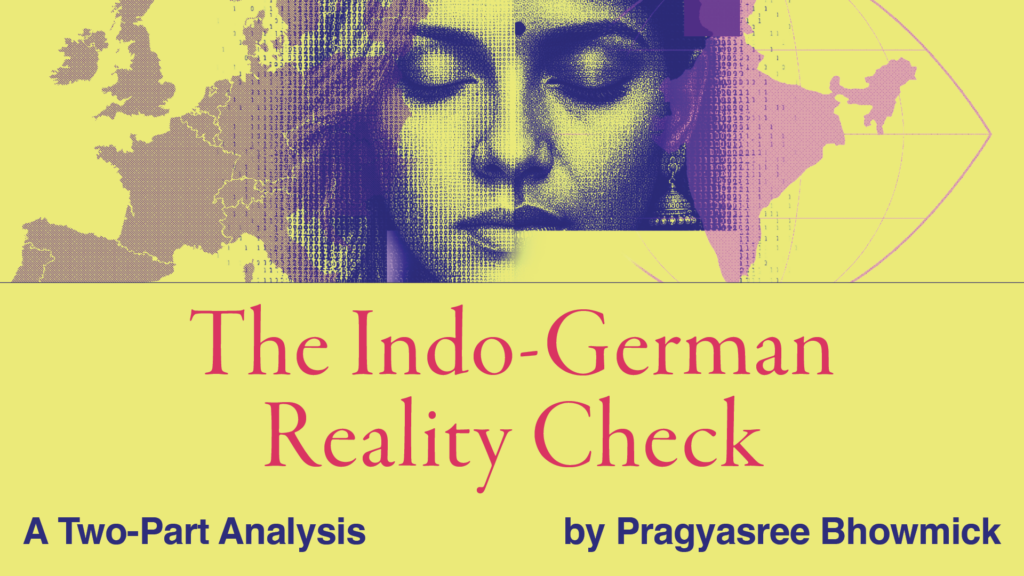
Technical brilliance alone does not guarantee success when two distinct corporate worlds collide. In our two-part analysis „The Indo-German Reality Check“, Pragyasree Bhowmick explores the unwritten rules of professional friction between Indian agility and German structural rigidity.
Systems of trust: navigating the friction in Indo-German work cultures
If we look at the lived experiences of professionals moving between India and Germany, the friction is rarely about technical capability. Instead, it stems from deep-seated differences in working styles and cultural exposure.
In many Indian professional environments, adaptability is considered a core strength. Rapid problem-solving, improvisation under pressure, and the ability to navigate uncertainty are celebrated as markers of competence. Deadlines may shift, plans may evolve, and personal relationships frequently play a significant role in facilitating outcomes. The phrase „We’ll figure it out“ reflects a broader culture of flexibility that has developed within one of the world’s most dynamic and complex societies.
German institutions, by contrast, tend to operate on a completely different set of assumptions. Planning strictly precedes execution. Processes are designed to minimise uncertainty rather than respond to it. Documentation often carries more weight than personal relationships, and predictability is valued over improvisation. For many Indians arriving in Germany, this can initially feel frustratingly rigid. Yet, for many Germans, these same structures are viewed as the foundation of fairness, accountability, and trust.
The hustle vs. the boundary
The differences become particularly visible in the daily workplace routine. Indian work environments are often characterised by high competition, long working hours, rapid growth expectations, and intense performance pressure. Germany, on the other hand, places a much greater emphasis on work-life boundaries, predictable schedules, and clearly defined areas of responsibility.
While many Indian professionals deeply appreciate these healthier conditions after arrival, the transition requires a significant adjustment in mindset. Success in the German system is measured less by constant availability or visible, exhausting effort. Instead, it is defined by consistency, meticulous planning, and strict adherence to established processes.
Polite deference vs. radical directness
Communication styles create another major point of friction. German workplace culture heavily favours directness, explicit feedback, and open disagreement. This includes expressing dissent directly to supervisors and senior management.
In many Indian contexts, where hierarchy carries greater social significance, criticism is communicated far more indirectly. Deference toward authority remains the cultural norm.
Consequently, a misunderstanding occurs: behaviour interpreted as confidence and transparency in Germany may be perceived as confrontational by an Indian professional. Conversely, politeness, restraint, and indirect communication from an Indian employee may be mistaken by German managers for uncertainty, lack of initiative, or a lack of competence.
Beyond language: decoding the unwritten rules
These differences are not merely cultural curiosities. They have tangible consequences for integration, career progression, workplace satisfaction, and social belonging. Many Indian students and professionals arrive with exceptional technical qualifications. However, they soon discover that success depends equally on understanding unwritten institutional norms and behavioural expectations. The challenge is therefore not simply one of language acquisition or credential recognition. It is a complex challenge of navigating two distinct systems of social and professional organisation.
Understanding this reality is essential. Many of the tensions that emerge within the Indo-German partnership are not created by formal policy failures alone. They arise in the space between differing assumptions about efficiency, trust, authority, and cooperation.
It is precisely within this unmapped space that some of the most significant opportunities – and frustrations – of the modern Indo-German exchange continue to unfold. What we need moving forward is a relationship that is not only politically ambitious, but structurally humane, socially sustainable, and genuinely prepared for the people expected to carry it forward.
About the author: Pragyasree Bhowmick lives in Germany and is a PhD researcher specializing in drug discovery and targeted therapies. Alongside her scientific work, she is passionate about media, storytelling, and science communication. As a presenter for All India Radio and, since 2026, an author to theinder.net, she combines research expertise with clear and accessible communication.