
Nearly half of researchers who leave academia cite poor supervision as a contributing factor in their decision: A 2026 international survey published in Nature, involving more than 2,600 researchers across 65 countries, found that almost 40 percent described their supervisors as disorganised or poor communicators. More than 30 percent reported a lack of support, empathy, or respect for personal boundaries. Almost half stated that their supervisor had significantly affected their mental health.
Every discussion about talent lost to academia should begin with another simple – and deeply uncomfortable – question:
How many Katalin Karikós have we already driven away?
Long before becoming a Nobel Laureate in 2023 and one of the architects of the mRNA technology that enabled COVID-19 vaccines, Katalin Karikó, a Hungarian scientist educated at the University of Szeged, spent decades being told that her work lacked significance. After emigrating to the United States, she continued her research on messenger RNA despite repeated scepticism. Her grant applications were rejected. Her work was repeatedly sidelined. She was demoted four times at the University of Pennsylvania and repeatedly advised to abandon her research altogether.
The very scientific establishment that later celebrated her discoveries had once considered them unworthy of investment.
History remembers the triumph.
It rarely remembers the neglect that preceded it.
Karikó survived because of extraordinary persistence. Scientific policy, however, cannot be built upon exceptional resilience. For every scientist who survives institutional failure, countless others disappear quietly.
Science should belong to every curious mind courageous enough to dream beyond the obvious: to those blessed with exceptional talent and fortunate enough to encounter mentors who recognised their potential; to those whose abilities were nurtured rather than exploited; and to those who were challenged without being broken.
But science must equally belong to another group: individuals possessing determination, aptitude, resilience, and intellectual promise, yet lacking the fortune of good mentorship, supportive institutions, or healthy research environments.
It is often this very group that academia continues to lose – not because they are incapable, lack commitment, or are unworthy, but because the system repeatedly asks them to survive conditions that no profession should consider acceptable. In doing so, science loses not only people. It loses possibilities.
This essay argues that academia’s talent crisis is commonly attributed to funding shortages, insecure career paths, or individual cases of misconduct. It argues instead that a deeper structural problem has received far less attention: the combination of inadequate mentorship and concentrated supervisory power.
The greatest myth in academia
Perhaps the most damaging assumption in modern science is the belief that outstanding scientists automatically become outstanding mentors. Nothing in academia supports this claim.
Researchers spend decades learning how to design experiments, write grants, analyse data, and publish papers. Yet many receive little or no formal training in leadership, communication, conflict resolution, mentoring, or people management.
A scientist may become internationally renowned because of expertise in molecular biology, artificial intelligence, chemistry, medicine, or physics. That expertise does not automatically confer the ability to guide another human being.
Yet academia routinely behaves as though it does.
In no other profession would we accept such logic. We do not assume that a brilliant surgeon automatically becomes an effective hospital administrator. We do not assume that an exceptional athlete automatically becomes a great coach. Yet supervisory systems throughout academia continue to rest upon precisely this assumption. The consequences are becoming increasingly visible.
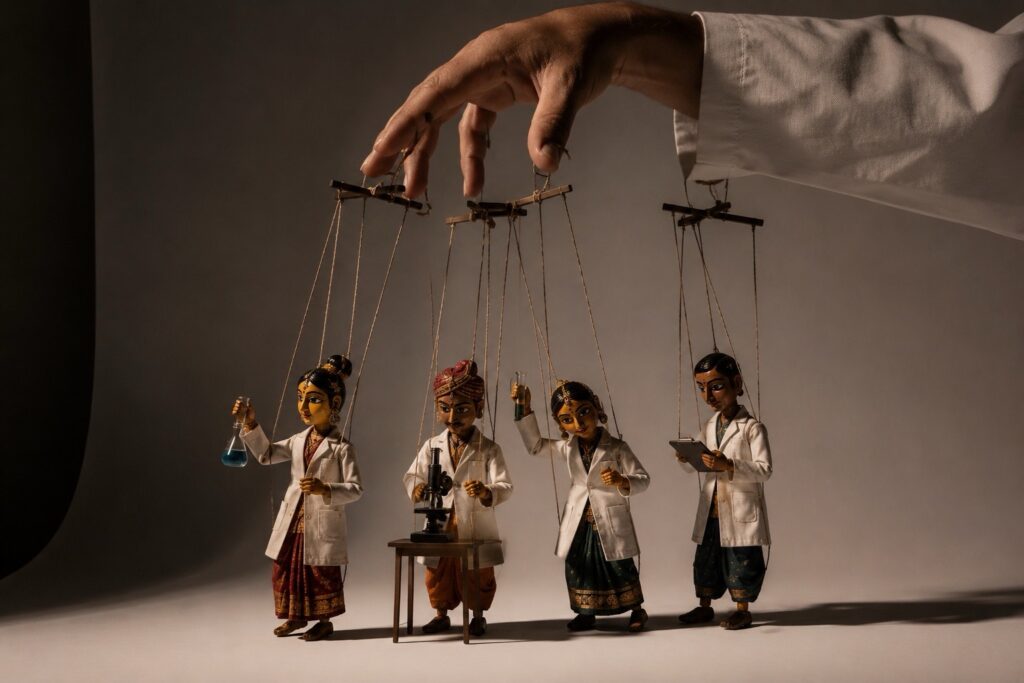
Poor mentors exist in every profession. What makes academia different is not simply that ineffective supervision exists, but that it is embedded within a system in which supervisors exercise extraordinary influence over the careers of those they oversee. A weak manager in many organisations can often be challenged, circumvented, or replaced. A doctoral supervisor frequently cannot.
It is this fusion of inadequate mentorship and concentrated authority that transforms ordinary managerial shortcomings into systemic risks for scientific talent.
When one person controls an entire future
This is where the core problem becomes clear.
Modern institutions generally distribute authority across multiple structures in order to prevent abuse. Academia frequently does the opposite. It concentrates professional power within a single supervisory relationship.
As a result, doctoral researchers and postdoctoral scholars often become dependent upon one individual for professional survival. A disagreement can become career-threatening. A conflict can become professionally fatal. Silence becomes safer than honesty, and compliance safer than independence.
What would elsewhere be manageable professional friction, mitigated by institutional safeguards and regulatory oversight, becomes in academia a systemic dependency, where one person’s judgement can quietly determine the course of an entire scientific career.
Few professions grant as much unchecked authority to a single individual as academia. Supervisors often determine access to funding, influence publication opportunities, decide authorship positions, control conference participation, shape professional networks, provide recommendation letters, and influence graduation timelines.
In many cases, they effectively determine whether a young scientist’s career advances or collapses. The problem is not merely power; it is power without meaningful accountability. Fear gradually replaces curiosity – the very foundation of scientific inquiry.
The loss of scientific talent therefore raises a fundamental question: Why do capable researchers leave?
Germany and India: different systems, similar vulnerabilities
Do these dynamics hold true across different academic systems? Germany and India may appear to have little in common academically, yet precisely this contrast makes the comparison instructive. Despite their different cultures, governance structures, and higher education systems, both reveal the same underlying vulnerability: when professional authority becomes concentrated in a single supervisory relationship, opportunities for abuse emerge regardless of the institutional setting. The forms may differ, but the structural problem remains remarkably similar.
Investigative reporting and documentaries examining some of Europe’s most prestigious research institutions have documented cases of intimidation, dependency, psychological pressure, and fear of retaliation among doctoral researchers and early-career scientists. The lesson is sobering: institutional prestige does not prevent abuse. In some cases, it may even conceal it.
Germany nevertheless demonstrates an important principle. Abuse can be investigated. Whistle-blowers can be heard. Journalists can scrutinise powerful institutions. Independent labour protections, ombudspersons, legal safeguards, and public accountability mechanisms create avenues – however imperfect – for addressing misconduct.
Yet access to these protections is far from equal. International researchers frequently work on fixed-term contracts under the Wissenschaftszeitvertragsgesetz (WissZeitVG) while simultaneously depending upon residence permits and visa renewals. For many, particularly international researchers such as Indian doctoral candidates and postdoctoral scholars working in Germany, challenging abusive supervision may place not only a research career at risk, but also legal residence, financial stability, and family obligations as well as financial responsibilities.
Recent Nature analyses published in 2026 highlighted growing insecurity among early-career researchers across Europe. Temporary contracts, uncertain career prospects, and dependence upon senior academics increasingly contribute to scientific attrition. These pressures are often compounded by experiences of exclusion, discrimination, and racial bias affecting international researchers, particularly those from the Global South. Numerous studies have likewise shown that minority and international scholars report lower levels of belonging, fewer mentoring opportunities, and greater barriers to career progression, contributing to the disproportionate loss of international scientific talent.
India presents a different, though equally troubling, picture. Academic authority frequently remains concentrated within rigid institutional hierarchies, leaving doctoral researchers heavily dependent upon a single supervisor’s approval for progression, publication, and career advancement. Although formal grievance mechanisms exist in many institutions, they are often perceived as lacking independence or practical effectiveness.
Several high-profile cases involving allegations of supervisory misconduct, prolonged institutional inaction, and student suicides have repeatedly triggered national debate over accountability within Indian higher education. These cases have reinforced longstanding concerns that existing grievance procedures often fail those who are most dependent upon them.
At the same time, scholars have argued that increasing governmental intervention and the erosion of academic freedom have weakened institutional autonomy within Indian universities. Political and bureaucratic pressures may reinforce existing hierarchies, making it even more difficult for universities to function as genuinely independent spaces of critical inquiry.
Germany and India therefore illustrate different manifestations of the same structural problem. One demonstrates that accountability mechanisms may exist but remain difficult to access, particularly for international researchers. The other shows how concentrated authority and limited institutional independence can make such mechanisms appear ineffective from the outset.
In both systems, those with the least institutional power often bear the greatest risks. And in both, scientific excellence alone offers no protection against the abuse of power.
Statistics are sterile – human experience is not
Academic power imbalances rarely announce themselves dramatically. They accumulate quietly. Questions stop after ridicule. Weekends disappear under unspoken expectations. Silence replaces protest because recommendations depend upon compliance. Harassment goes unchallenged because speaking up may cost years of work.
Many researchers find themselves trapped in a paradox: the very people responsible for evaluating their performance often shape the conditions that undermine it. Over time, curiosity gives way to survival. A sense of vocation becomes an exercise in endurance. Behind every publication metric stands a person who once believed they belonged in science.
The crisis in academia is therefore not merely one of funding or infrastructure. It is one of stewardship.
Mentorship is not the maximisation of research output; it is the development of human potential. A good supervisor should not be measured by the number of publications produced in their laboratory, but by the number of independent scientists who are ultimately able to flourish without them.
At the same time, many supervisors themselves operate under immense institutional pressure. Funding insecurity, publication metrics, and increasingly competitive evaluation systems reward output far more readily than good mentorship. This does not absolve individuals of responsibility, but it does make one thing clear: the problem is fundamentally structural, not merely personal.
Slower, more sustainable research that protects people is not a compromise. It is an improvement.
Science has never lacked talent. What it has lacked are systems capable of protecting it.
And perhaps the most revealing characteristic of modern academia is not what it produces, but what it fails to measure. It tracks publications, citations, grants, and rankings with extraordinary precision – yet it has no equivalent way of accounting for the talent it quietly drives away.
References
- Poor supervision is pushing young researchers out of academia, Nature, by Mohana Basu, 01.06.2026
- How should I respond to race-based exclusion in my lab?, Nature, by Christine Ro, 23.06.2026
- Academic Freedom in India, Book: University Auto Decline, by Niraja Gopal Jayal, published 2022
- Gesetz über befristete Arbeitsverträge in der Wissenschaft (Wissenschaftszeitvertragsgesetz – WissZeitVG), Bundesministerium der Justiz, 12.04.2007
- Handreichung zum Wissenschaftszeitvertragsgesetz (WissZeitVG), Deutsche Forschungsgemeinschaft (DFG), 17.03.2016
Article reviewed by: Uttaran Das Gupta
Uttaran Das Gupta is a writer, journalist, and PhD researcher in Media and Culture Studies at Birmingham City University and Associate Professor and Assistant Dean at O.P. Jindal Global University, whose work explores literature, cinema, politics, and popular culture. He previously worked for leading news organizations including The Times of India, The Wire, Business Standard, Deutsche Welle, and the Financial Times, and is the author of the poetry collection Visceral Metropolis and the novel Ritual.
Edited by: Bijon Chatterji, PhD
Copyrights (c) by theinder.net