
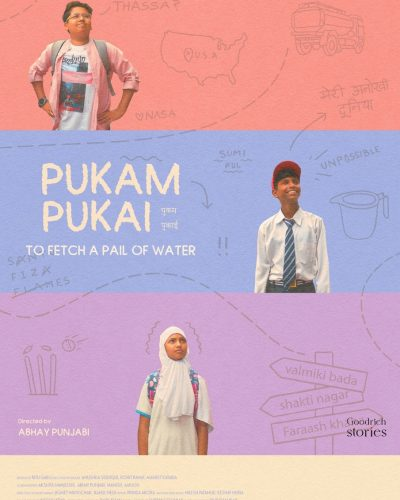
On Monday, 28 September, Abhay Punjabi’s feature film Pukam Pukai – To Fetch a Pail of Water will be screened at the 49th LUCAS International Festival for Young Film Lovers in Frankfurt. Punjabi will attend the screening at the DFF cinema and take questions from the audience afterwards. theinder.net’s Pascal Gras spoke with Abhay Punjabi about the film, his path to filmmaking and the stories behind Pukam Pukai.”
The film follows three 12-year-olds from very different social and religious backgrounds in Delhi: Santu, Vivan and Fiza set out to do something that seems almost impossible – build their own swimming pool. Behind their adventure lies a story about unequal access to water, social divisions and friendship across boundaries. Yet Pukam Pukai tells it with humour and through the perspective of children.
theinder.net met Abhay Punjabi at the Indian Film Festival Stuttgart in July 2026. Pascal Gras spoke with the filmmaker about his unusual path from ornithology to cinema, the personal experiences behind Pukam Pukai, working with young actors – and why cinemas still matter.
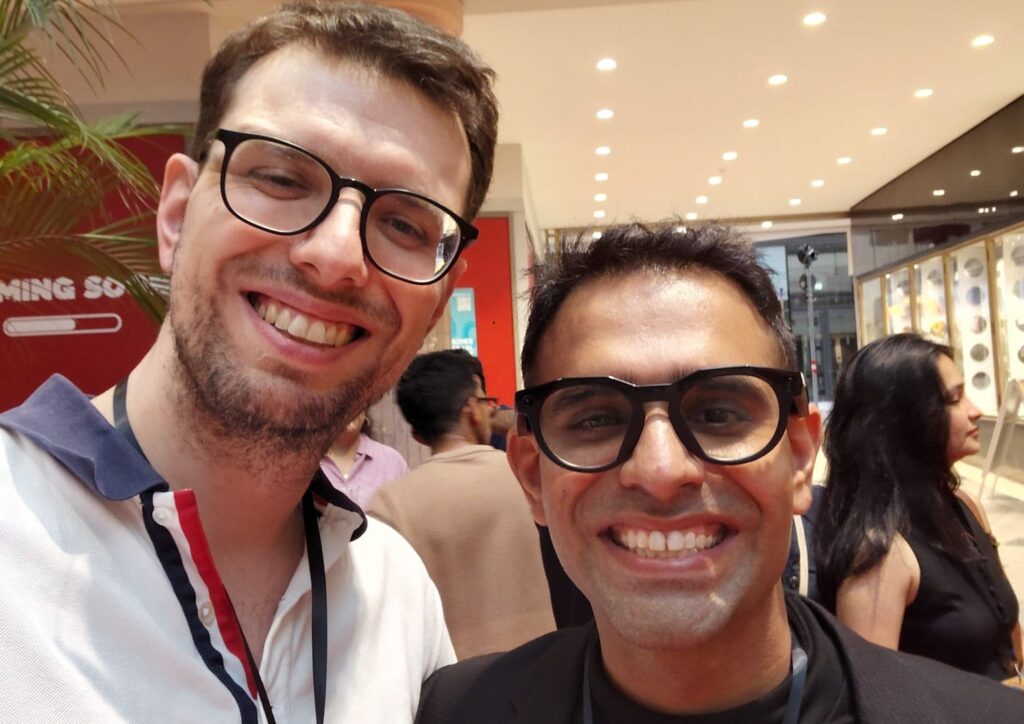
Pascal Gras: You studied zoology and ornithology before becoming a filmmaker. How did you find your way from studying birds to making films?
Abhay Punjabi: Okay, so it was accidental. I wanted to be in a college where there were a lot of cultural societies in which I could do a lot of art, and my grades were only—I wanted to do physics, so a physics major, but in that particular college, I could only qualify for zoology. So I took up zoology. That was my second favourite subject after physics. And yes, in that time, I explored dancing, and the closest form of art to dance was editing. I wanted to be an editor because there’s a rhythm to it, and I was exploring editing. That’s how I shifted from dancing to editing, then direction, and then scripting. And that’s how the shift came. But yeah, I was always interested in these cultural, creative activities and emotions, and I love listening to stories. And ornithology because birds fascinate me. Bird behaviour and interesting birds in tropical areas and migratory birds have different behaviour in the zone wherever they are throughout the year, going through the globe freely. Really, they don’t need visas. (laughs) And so, yeah, their behaviour changes. I was always fascinated by that.
Pascal Gras: Since you mention birds: Stuttgart actually has a wild population of yellow-headed Amazons in Bad Cannstatt. The population apparently originated from escaped birds and has established itself here.
Abhay Punjabi: Wow, where are they from? Near Stuttgart?
Pascal Gras: Here in Stuttgart, in Bad Cannstatt. Around five kilometres from the city centre.
Abhay Punjabi: Can I go and see them?
Pascal Gras: Yes, you should.
Abhay Punjabi: Have you spotted them?
Pascal Gras: Me personally, never, because I was not lucky enough. But you have to go in the evening because they apparently have their sleeping trees there. So that was our little bridge from ornithology to the Stuttgart Film Festival. (laughs)
Abhay Punjabi: Thank you so much for telling me!
Pascal Gras: What was the original inspiration for Pukam Pukai, and why did you want to tell this story as your first feature film?
Abhay Punjabi: I felt that there is a growing distance between people of my age and younger people. They are not interacting with people of other religions, people from different faiths and people from different castes. And this distance is growing because of our Instagram algorithm also. We are just interacting with those people from ours, and it’s very limiting to break that because we are so involved in our phones and then the circles we are in. That’s why I felt that it is something I need. And there was some growing inequity around, and it’s everywhere in the world, so yeah, because of various challenges this had to be addressed at a children’s level because I want the coming generations to not prejudge who they are talking to or limit their interactions just within their own communities. And so that’s something I wanted to break through, and because I’ve learned so much from my friends.
It is also a cultural thing, like I come from a Hindu culture; I was married to someone who was a Muslim, and then because the first time I went to her house—my usual greeting is I bend to touch feet, that is a very Hindu thing—so I touched feet, and that was very funny because they never do it. So I had to put that somehow in the film, and I had to bring those nuances also somehow. So I felt it can be funny, it can be interesting. So yeah, these anecdotes inspired me.
Pascal Gras: So there is quite a lot of your own life in the film?
Abhay Punjabi: Yes. There was a lot of personal touch. Yes.
Pascal Gras: Santu, Vivan and Fiza come from very different socioeconomic and religious backgrounds. How did you develop the three characters, and what connects them?
Abhay Punjabi: It was four of us, the writers of the team. They come from different backgrounds. One of them comes from a very upper-caste background, the girl, and then this boy, Manish, who’s playing Mangali, comes from this background of a lower caste, and I come from a privileged background but kind of distinct from both, so managing somewhere in the middle. So all these interactions and all the team of writers, we always had these conversations around how and why. The “why” was always key because this has to be addressed in the world and through kids only, and it cannot be something which usually is very sympathetic.
You feel pity for someone who doesn’t have water and you feel sorry, “Oh, he comes from this background, that’s why he doesn’t have.” So I wanted—we wanted—we strictly discussed that in the film: the agency should be with the kids. They should decide what they are making. It should not be like the director’s brain or someone else’s voice in the film, which sometimes we fall into, especially in children’s films. We have an adult gaze. But, so yeah, in those interactions we could address these problems and we could address how the agency should remain with the child and how they can form their own decisions. And at no point should you feel sorry for any of the characters and for their challenges. So that was how it was figured out.
Pascal Gras: The three young actors give very natural performances. How did you cast them?
Abhay Punjabi: So I had a team like—I don’t know if you’ve seen Life of Pi. So the casting director of Life of Pi was the casting director of our film as well, and he’s super cool. He worked out of generosity. I just narrated him 15 minutes of the story and he said, “I’ll do it. I’ll do it for you.” And he gave me so many auditions and he sent his team across Delhi to various areas of Delhi. And for each character, there was a different person allocated: you go there and you go into this neighbourhood and you find people. So he was super cool and he gave me around 700 auditions (laughs) to see through, of all of them. He must have skimmed through more than that. So because of that I could find my Santu and my Fiza. I also wanted them to be originally from that. So Fiza is also in real life slightly like half Muslim and half Hindu. So she has knowledge of the culture. So I wanted them to be aware and have been born in such surroundings.
Pascal Gras: The film deals with water scarcity, social inequality, parental pressure and gender barriers, yet it remains warm and humorous. How did you find that balance?
Abhay Punjabi: It was a lot of scrapping and rewriting and writing and rewriting and putting in our real lives. All four of us. All four of us had something to do with every scene and had some input of humour. The dialogues were written; we would go record the conversation of local people and then incorporate those words like “tasa” and “basha”. These words had to be incorporated from the local areas, that’s how those dialects came into place. It made it a little more authentic. The social issues with water, I don’t know global politics or anything like that, but in India groundwater has been exploited to the point where it is now; chromium poisoning has happened, we’ve gone too deep into the ground and there’s heavy metal poisoning. We should not exploit, also because of all the AI structures that are coming in, so water is not accessible for everyone anymore and it is a privilege for those who can afford it.
Pascal Gras: And the inequalities are often visible within very short distances.
Abhay Punjabi: Yes, there is a heavy social inequality. Those things have to be put in through humour, that it turns accidentally into the slum area from the privileged area. All these three locations are in reality exactly like that, they are like 500 metres away from each other. But there is water inequality.
Pascal Gras: The swimming pool begins as a simple childhood dream but gradually becomes a symbol of privilege and inequality. What does the pool represent to you personally?
Abhay Punjabi: So swimming pools have always been only for the privileged. The first time I saw a swimming pool I was 15 years old and that’s the first time I could go into a swimming pool and I was obviously fascinated by the blue water and all of that. Some of my friends had never seen one till they were adults. So that swimming pool is kind of a privilege and also the purity around water. Someone touches water from a caste background, like even a lower-class person, if she touches—even though it is a precious resource. Some people from a high class would put separate glasses for people from a different class inside their homes, they would isolate them. They would serve them water in a different cup or different glass. So yeah, there has been discrimination about water till recent times, but things are changing. It’s getting better now and people are evolving.
Pascal Gras: How did you approach working with actors of that age?
Abhay Punjabi: I think that was the easiest thing because I could be with them as them. That was kind of—I could be with them as they were and I gave them agency to decide their own dialogues, their own anecdotes.
Like they chose—even now, I’ve asked all three of them to write, like Richard Linklater, ten years beyond the cast story, like when you meet when you’re 22, how would you meet, where all would you be if these friends, the characters, come together? And they are constantly brainstorming, “Oh, we could have been in the US” and “you’ll be playing cricket” and “you might be an archaeologist”. So that’s what they contemplate.
And because some of the anecdotes in the film have been used which were given by them, like there is this “tunali, you’re drain, I am a mosquito and he is garbage”. So this came from the kids, we didn’t impose. We were struggling, we were finding some metaphors, some deep meanings and some analogies we were looking for. But it was very natural for them to decide these things for themselves.
So like even Santu would say, “My favourite colour would be blue, obviously because I want the food.”
So those were their thoughts only and so we would discuss about the character. We wouldn’t give them scenes as is, because if we tell them the lines they will mug it up and they will just speak it very emotionlessly. So we would talk about what happened before in their life, what just happened after the scene. We would not tell them what will happen in the scene. We would just explain. So this is where things were and because we didn’t shoot everything linearly, we would tell them what happened before and after and then they would do it themselves. Lines were written, but we did not heavily rely on telling them, “Learn it up.” We did not want them to learn the lines. So that made it slightly organic. It helps with the kids.
Pascal Gras: Why did you choose Delhi as the setting?
Abhay Punjabi: That was just honest, because I have been there and that’s my childhood. But I think it could have been any city of India. It could have been any city of the Global South, I think, not just India, maybe even any other city in South Asia. Similar challenges are there with pollution, contamination, water issues, so all of these things are normal in Delhi. It was also organic to all of us in the writing team. But yeah, otherwise it could have been anywhere, but Delhi has been globally at the top of the most polluted cities for over ten years now. I did not add much to the conversation around environment, because it was more about dreams, but whatever we could touch upon inequality we did.
Pascal Gras: Delhi’s air pollution is well known in Germany too. Images of the city under heavy smog occasionally appear in the German media.
Abhay Punjabi: Yes, exactly. I have learned that apparently the air pollution can filter heat a little bit. It’s very good to shoot because it does a hazy effect, so for camera it works, but for people’s lungs it does not. (laughs)
Pascal Gras: Is there one scene that has stayed with you particularly strongly after completing the film?
Abhay Punjabi: That’s a difficult question. I’m so attached to every scene. Like today, I can only think of one scene. So, I’ll tell you about today.
The scene in which both Santu and Fiza, in the punishment, are talking, introducing each other in the beginning. That happens in the beginning and Santu gets to know about, “Oh, you are from that area where my mom has said not to go” and “you guys eat meat, a lot of meat”, and he loves meat but still in Hindus we are kind of, although we eat meat, but then we are not as… so we would sometimes not eat meat. So those kinds of conversations are tricky and those were happening. So that scene I really like and that stuck with my memory.
But again, every scene is my favourite scene. The scene in which both the kids go with Plan C to the kid, that’s a funny scene. And if you know Indian culture more, it’ll be funnier. And the interaction with the white guy, white coach, they would call him, “Why are you extra white today?” (laughs) So these funny interactions, those kinds of, if they land, I feel happy.
Pascal Gras: The film previously had the working title Dubki and is now called Pukam Pukai – To Fetch a Pail of Water. What does the new title mean?
Abhay Punjabi: Okay, so Dubki was our working title when we were in the process of making it, and then when we applied in India, we had to apply it to the censor and someone was already holding on to that title. There is no film that has come out with that title but someone is holding on to that title. So we could not get it.
Then we had to choose the second and Dubki, we felt, was just about Santu, which is just about one character. And then Pukam Pukai came as the second-best title and “to fetch a pail of water” is like an English poem, right? “Jack and Jill went up the hill to fetch a pail of water”, so “to fetch a pail of water” was very poetic, so that’s why its English title is To Fetch a Pail of Water.
And Pukam Pukai is just a game in which trios, three people, play the palm flip to select. It’s a game before a game, like if you’re playing hide-and-seek or tag. So to select who goes first, they flip palms and three people would flip palms and two of them are supposed to get the white side and one gets the dark. So the dark one has to choose who to and he’ll be the seeker in hide-and-seek. So that’s how it usually turns out. That’s the game.
Pascal Gras: So you have solved the mystery of the title. (laughs) Here in Stuttgart, the film was presented to a family audience. How does it feel to see such a specifically Delhi-based story reach children and families in Germany?
Abhay Punjabi: I am just excited because it’s so generous of Oliver—Oliver Mahn, Director of the Indian Film Festival Stuttgart—and the team that they chose my film to do this, and I think the experiment landed well with the people. I hope it did. I wish if they can share on Letterboxd or something, I’ll get to know more, if there are any other platforms they can talk about it then I would get to know about how it landed. But I could see from the reactions sometimes, because they got it and they were moved. I could see a few people even had a tear when Santu did the last time.
Pascal Gras: What do you hope audiences here recognise in these three young characters despite the cultural distance?
Abhay Punjabi: I just think they should take back that India is not just like a poor country and with people not having resources. But everyone has their own agency and the kids out there are creative and despite whatever challenges they have, they are just go-getters and they would make things happen. And obviously everywhere in the world, I think kids have shared dreams if they can go out of their devices and have real friendships and have real friends from across cultures and across value systems. I think that makes the world richer and better and yes, so that’s what I think people should get from it.
Pascal Gras: If you had to describe your experience of the Indian Film Festival Stuttgart in just three words, which would you choose?
Abhay Punjabi: Team is unstoppable. I mean, despite challenges of funding and all, they are just unstoppable. They would make things happen even when there can be challenges. Like I heard in the previous screening they had to stop a festival and one of their screenings is happening with these guys because that festival stopped happening because of funding issues from a neighbouring city. These guys—it was an environmental film festival. So, they have to manage resources and I hope they continue to do it. It’s the 23rd edition. I hope it keeps going on.
It is challenging to pull people now to the theatres everywhere on the planet and just this kind of an audience, if it keeps coming and you don’t have to promote it a lot and still they are managing to come, I think organically that’s great. I hope that continues, because the big-screen experience, if it goes once—I’m staying in a hostel close by. I saw there is one theatre which is shut down near my hostel. Very big cinema posters are still there and I could see that it has been shut recently or something. I could see posters from last year on that.
So yeah, I feel cinemas should keep growing, because it gives a community the experience and you know the person walking out with you is walking with the same emotion that you are feeling, and that doesn’t happen on a Netflix screen, that doesn’t happen anywhere else and it should remain like that as long as they can keep it running.
Pascal Gras: Even with a large television or home cinema, it is simply not the same experience.
Abhay Punjabi: I, as a filmmaker, don’t respect other people’s cinema when I watch on my phone while their film runs on the cinema screen. The moment my phone rings, I’m looking at it and it’s the second screen running in front of me and that makes the quality of the film even worse. And Netflix has protocols now to make it friendly for second-screen viewings, which will make it dumber. The cinema will become dumber because of that and so dumbing it down is not the answer to second-screen viewing, I think. It’s this experience.
Pascal Gras: Looking ahead, how do you see the Indian Film Festival Stuttgart developing its role and visibility within the international festival landscape?
Abhay Punjabi: As an Indian diaspora festival I’ve heard this is the best across the planet, that’s what I’ve heard in the diaspora circle. More than half the audience were not even from the Indian diaspora in my film, and even in other screenings that I was at, there were more people from Germany who were interested in Indian cinema. So they have some trust.
Also in the hostel I’m staying at, there is a lady who came from Bonn just for this festival, because she has been coming here for all this while and she was sad that the IFF Stuttgart 2026 was one day shorter than usual. It used to be five days. She’s watching the next film now after she saw my film; she also watched the morning film. I can only watch two films in a day and she’s watching almost all films here, because she wants to get as much out of her trip from Bonn, which is wonderful.
That says how much trust there is in Oliver’s team and their selection. They chose Malayalam cinema this time, the focus is on that, even though my film is a Hindi film. But yeah, Malayalam cinema is known for its story, its values and because that story they put in all the effort in the story, more than anything, and that’s what we look up to Malayalam cinema for that.
I’m glad they are not looking for the mainstream, now they are looking for parallel, so that just invokes more trust every now and then, so I’m happy how Oliver is managing and even their team is dedicated. There are volunteers working, however challenging it can be to pull off. I hope these three days were worth it for them.
Pascal Gras: Thank you very much for the conversation.
Abhay Punjabi: Thank you, Pascal. Really, thank you so much.
Pukam Pukai – To Fetch a Pail of Water will be screened at the 49th LUCAS International Festival for Young Film Lovers on Monday, 28 September 2026, at 5:30 p.m. at the DFF cinema in Frankfurt. Abhay Punjabi will attend the screening and take questions from the audience afterwards. A further screening takes place in Offenbach at 11:15 a.m. at Kino im Hafen 2.