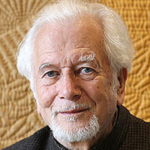
In his renowned speech, the traditional Indien-Rede 2026, entitled „The Evolution of a Nation – My Experience of Fifty Years in India„, delivered at the Trier India Days of the Deutsch-Indische Gesellschaft Annual Meeting on 25 September 2026, Tagore Award laureate and recipient of Germany’s Federal Cross of Merit Martin Kämpchen reflects on five decades of profound change. Published here exclusively, his personal account traces India’s transformation from the 1970s to the present — and turns to the young generation he sees as central to the country’s future.
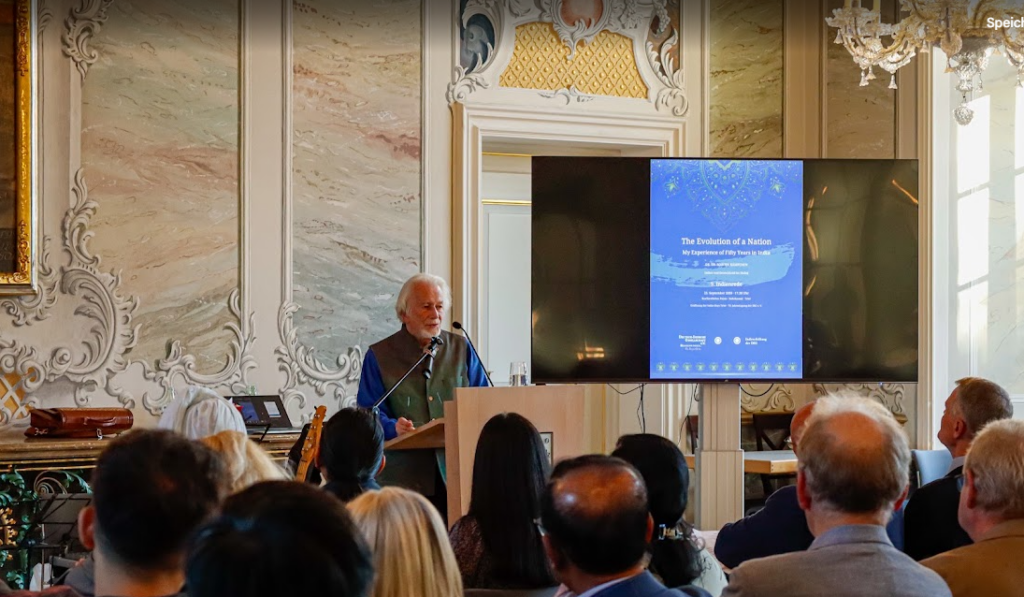
In India, a person like me is visibly not a newcomer to the country. Dress and demeanour will set me apart from tourists. So, people will not hold back their curiosity but approach me with the normal question: “How many days have you been in India?”
My reply is: “I am no longer counting the days.”
Such an enigmatic reply will never satisfy an Indian interlocutor, and he or she will press me until I come into the open with my statement: “I am in India for fifty years now.”
“Fifty?” A shocked, incredulous silence will follow. While young people of the Indian middle class will consider their urgent wish to leave India for a Western country as natural, the reverse wish – of a German wanting to live in India – will surely be seen as unusual and in need of an explanation.
I have been such a person who had to constantly clarify his decision to live in India both in Germany as well as in India. In the bargain, however, I received an extraordinary life experience.
Approaches to India
M. K. Gandhi was the first Indian personality I studied in detail. He became part of my early decision to be a Conscientious Objector, that is a person who opts to refuse military service with a weapon. In the late 1960s, military service was obligatory in West-Germany. As an 18-year-old teenager, I studied Mahatma Gandhi’s principles of non-violence and cited them to defend my decision before a panel of generals and government officials.
I made the second step towards India when I became interested in the Ramakrishna Movement, that is, in the educational activities of the modern Hindu Monastic Order, the Ramakrishna Mission. I applied for a three-month travel-grant to visit India. In 1971 – I was barely 21 years old –, I flew to Bombay and from there I took the train across the breadth of North India to Kolkata. In those times, this was a trip of two days and two nights. The atmosphere was gemütlich, convivial; everybody chatted with everybody else. And arriving in Kolkata, I had made my first set of Indian friends. It was my first experience of that Indian genius of communicating and connecting with others, often total strangers.
I learned to appreciate and enjoy that ability and craving to communicate. In my opinion, it is a main feature of the Indian character. It is a feature, I venture to say, which keeps this nation together as a cohesive whole. Long before the internet created the term “networking”, Indians have been skilled at it by a constant exchange within the family, the neighbourhood, among colleagues and in ever wider groups. It has always been a mixture of sincere caring for another and a way to avoid boredom. In Bengal we have a special term for it – adda.
For a full month I stayed with the Ramakrishna Mission Institute of Culture in Kolkata, invited by its founder, Swami Nityaswarupananda. He was my first teacher of Hindu spirituality. During meals which we shared, the Swami conversed with me about the Unity of Mankind and the spiritual Oneness of all that exists. He was a deep believer in Vedanta and talked about it with the clarity of conviction.
During my initial three months in India I was convinced that I needed to return to India. I still had understood so little. Swami Nityaswarupananda invited me to return to India after I had completed my studies in Europe. Two years later, in 1973, my Ph.D. in German Literature from Vienna University complete, I was back in Kolkata and took up my obligations as a teacher of German at the Ramakrishna Mission Institute of Culture. It was my good luck that I was assigned a room in the Ramakrishna Mission Ashram of Narendrapur, south of Kolkata.
India in the Year 1973
Let me review the condition of the nation in 1973. Television had not arrived. Radio was restricted to the government Akashbani-channel. Yes, the film industry was already very active in Bombay, but producing mainly black-and -white films. The Kolkata film industry was in its nascent state with film director Satyajit Ray as its powerful figure head. Computers were far away. Type-writers of the heavy and bulky type, were visible only in government offices who all employed typists to take dictation and do the typing. I carried with me in my suitcase a much smaller version of a type-writer, the so-called Reiseschreibmaschine – the “travel typewriter” – which was entered in my passport to avoid my selling it off in India.
The Congress government was still firmly in place both in Delhi and in West-Bengal. At that time, it was difficult to imagine that there would be any change of party-rule anytime soon. Noticeably, it was still the era of post-Independence. This means that many stalwarts of the Freedom Movement were alive and identified with the ethos and idealism of the struggle to break free from colonial rule. The Gandhian non-violent atmosphere still impregnated the air. Gandhian followers like Morarji Desai, Indira Gandhi and Jayprakash Narayan ruled politically or dominated public opinion.
I remember the discussion that the Bhoodan movement around Vinoba Bhave inspired. Or the intellectual dominance which President Sarvepalli Radhakrishnan exerted over the county. In Madras, now Chennai, I saw the controversial sage Jiddu Krishnamurti exhort large audiences. Several times, I witnessed Indira Gandhi in Santiniketan and in Madras speak in her measured and authoritative manner.
Looking back, I realise how strongly Indian public life was in the initial stages of finding its self-confidence and spiritual authority after the centuries-long colonial subjugation. On the world-stage, India was one of the leaders of the Non-Aligned Movement. Meanwhile, this Movement has faded away as the member nations saw no common ground. East and West are no longer monolithic blocks; they have diversified. But surprisingly, in the last decade, India has once again gained a strong middle position between Western countries and Russia and China.
Life with Hindu monks and Christian Fathers
I was given a cell-like room in the Ashram of Narendrapur. There, I lived side-by-side with the monks and was allowed to participate in their lives as fully as I chose to. Imagine a Benedictine monastery accept a pious Hindu to live with them! Especially fifty years ago, this would be unimaginable. At the Narendrapur Ashram I was even given charge of looking after a small temple – cleaning it, decorating the images with flowers and worshiping them with incense sticks. Such spiritual openness was the hallmark of the Ramakrishna Mission Order. In contrast to this, when I travelled through North and South India, many temples were not open to me, a non-Hindu.
Other monuments of national importance were open to me only by spending tenfold the amount Indian citizens needed to pay. How was one able to distinguish between an Indian and a foreigner? Obviously by looking at the colour of their skin.
After teaching at Kolkata for three years, I moved on to South India and lived for three years with Jesuit Fathers in Madras. I was extraordinarily lucky, because, staying with the Ramakrishna Mission monks, I was able to study and imbibe the daily practises and the world-view of a form of Hinduism which is modern and adjusted to the current needs of Indian society, like providing education and health services along with spiritual caring.
Staying with the Jesuit priests in Madras, I was able to study the evolution of the Indian Christian churches from a Western-oriented missionary church with its emphasis on education, health-care and community-building, into a church which adapts Indian ways of life and accepts Indian forms of worship and spirituality.
In the 1970s, the Indian churches began to build ashrams all over South India, following the models of ancient Hindu ashram-communities, and welcomed Hindus and Christians as guests. It was a development which began to break the barriers and misconceptions lasting several centuries between the Hindu community and the Christian churches.
Communicating in English and in the Mother-Tongue
One particular legacy of the Christian churches, its insistence on competent English-medium education, has – in the last fifty years – transformed Indian urban society. It can no longer be wished away or supplanted by vernacular education in regional languages. Why? First, English has, by and large, been accepted as an Indian language with its very own distinctiveness. Second, English is the window into the world, enabling and facilitating the study at universities in India and abroad, enabling trade with the world, and keeping informed about and participating in world affairs.
However, there is a reverse side to the obvious necessity to be conversant in English. Let me elaborate. In Kolkata, I worked as a German teacher and in Madras I took an M.A. course in Indian Philosophy at the University. During these six years, I read intensely about Indian religions, Indian philosophy and literature. I worked myself through the eight volumes of Swami Vivekananda’s Complete Works and through the Gospel of Sri Ramakrishna – the conversations of Ramakrishna with his disciples. It opened for me a deeper – a spiritual and emotional – understanding of Hindu society.
But all this reading and study was in English. Although making this enormous effort to understand and appreciate, I realised that I was still lacking one particular key with which I could unlock the treasures of the Indian mind. What was this? – I had to learn one Indian language. So, I returned to West-Bengal, enrolled myself at the University in Santiniketan, at Tagore’s University Visva-Bharati, and learned Bengali. This was, to me, a decisive step. Learning Bengali, I began to fathom the deep connection of the Indian psyche with sabda – with the Word – which is the divine origin of creation. The mother-tongue is the root penetrating deepest into human existence. With amazement and wonder did I witness how heart and mind opened up to me when I began to converse with people in their mother-tongue Bengali.
Here we have before us the specific complexity of the Indian situation at our moment of history. The knowledge of English has become of paramount importance for Indians to communicate with the global community, but also among each other. In fifty years, the interconnectedness of the different Indian regions has intensified a hundredfold. This is due to an improved infrastructure and a quicker and easier mobility from one end of India to the other. Fifty years ago, airlinks between the metropolitan cities of India did already exist. But for a middle-class person it was unthinkable to fly from, say, Bombay to Kolkata, or from Madras to Delhi for a pilgrimage or a sightseeing-trip. Slow-moving trains were the normal means of transport.
This is different today. First, from Santiniketan I, for example, no longer need to travel down to Kolkata to catch a flight to Delhi or Mumbai. Instead, I take a taxi or a bus to Durgapur, cutting travel time in half, for a flight to Delhi or Mumbai. The density of airports across India has increased immensely. Second, boarding a domestic flight I see families probably belonging to the lower middle-class confidently claiming their seats and following the usual flight procedures. The power of English as a link language remains evident at every step.
However, of equal importance is to remain rooted in my language of origin in order to maintain my identity, my relationship with the deeper self, with my soul. And I emphasise that Indians remain basically shut to us non-Indians unless we are able to communicate in their native languages.
I have witnessed many examples of Indians who grow up knowing only English become deracinated and begin to search for their deeper identity all their lives. So, while the study of English must continue and progress for the good of the nation, the nurturing of the mother-tongue should never be abandoned.
The Indian Population Doubled in Fifty Years
When I arrived in India in the mid-1970s, the Indian population stood at 650 million inhabitants. In the last fifty years, the population has more than doubled. It is approximately 1.4 billion now. When I am asked to speak about the changes in the last half-century, this doubling of the population is an important – perhaps the most important – driving force of change. The entire infrastructure had to expand in a hurry. Electricity, water supply, housing, streets, automobiles, two-wheelers, then supply chains, warehouses, supermarkets, factories… you name it!
Europe had at least one-and-a-half centuries to evolve from an agrarian society into an industrialised urban society. Thereafter, Europe required another fifty years to march into the internet age. India had to cover the whole distance from an agrarian society in five decades, while constantly trying to keep pace with an exploding population. The haste is visible right from the mega cities to the villages. Where was the time for a far-sighted and well-discussed plan and a step-by-step execution which kept in mind future expansion and alterations, keeping in mind environmental requirements and the demands of a changing climate? Housing, water and energy supplies had to be made available to millions in a tearing hurry.
I have watched this development in and around Santiniketan where I have spent over forty years. Ugly tiny brick-houses came up in villages originally dominated by mud-huts. Electricity and water-supply, toilet and kitchen were not part of the scheme, so the brick buildings remained mostly unused. Village roads were given a cement surface causing rain water to remain stagnant. And in the city of Kolkata long rows of multi-storeyed buildings shot up, each one designed exactly like the other. A huge waist of talent, I felt.
In the last twenty years, the so-called gated communities made an entry, and meanwhile form a half-circle around Kolkata. We see apartment towers rising a few dozen storeys up, protected by high boundary walls. This deluxe life-style (which now becomes affordable for more and more people), is kept separate from the life of the “ordinary” population. What is more, such a gated life does not conform to the life pulse of Indians, no matter whether they are well-to-do or poor.
I have also seen remarkable progress. The villages in West-Bengal whose development I have observed, may still be called comparatively “poor”, but there is no more hunger. Tuberculosis is as good as eradicated, so is leprosy. Malaria is rare.
I observe an incongruent and half-way execution of the various schemes providing for a massive population. What is desperately needed is a vision for the future requirements of the entire population and an earnest execution of the schemes providing them. Of course, I am aware of the staggering problems the Indian bureaucracy faces. A well-known Indian journalist once told me, with a gesture of resignation: “Everything you touch becomes big in India.”
It is a manifestation of the resilience of the Indian population that, with all the every-day-problems it faces, it keeps on moving forward and it maintains, by and large, social peace. Putting it more pointedly, I believe it is a manifestation of the inward strength of the Hindu religion, as I got to know it. Or, quoting an amusing saying which I have often heard and myself repeated often: “India only runs by the grace of God.”
The Magic of Connectivity
When I arrived in India in the mid-1970s, I could not contact my parents except with the help of a public phone at the Post-Office. A clerk registered a call, then I waited indefinitely, maybe 15 minutes, maybe two hours, for the call to come through. Afterwards, I paid the relatively high rate. I never made use of this opportunity. After leaving Germany, I heard the voice of my parents only when I returned for a visit two years later. Today, this is impossible to even imagine in Germany or in India. We are used to instant connectivity.
The next stage was when phone booths sprang up at every street corner, and phoning became easier, but remaining expensive. Later, we were allowed to install phones in our private homes, and after another ten years or so, mobile phones became a common sight.
The two innovations which revolutionised Indian society have been television and the mobile phone. I remember the time when black-and-white television arrived in Kolkata. At the Narendrapur Ashram, even the monks thronged the tiny television set in the evenings. Slowly, television became the principal tool of entertainment for the general population. I see these tiny television sets dangling from the ceiling in many slum huts. There may be poverty, but television becomes a necessity like sleep and food.
It connects effortlessly with the Bollywood film industry. After all, television is cheaper than a ticket for the cinema. All along, I was aware that the Indian people are absolutely enamoured by, thirsty, almost greedy for visual impressions. Apart from sabda, from the desire to talk, to express oneself in words, comes this deep desire to see, to encompass the entire world with one’s eyes. Rabindranath Tagore wrote this charming play “The Post Office”. The young boy Amal who was close to death, had this one desire left in him: ami dekhbo kebal dekho! “I want to see, forever to see!”
In the villages I sometimes played a prank on the children. I stood on a village path and looked intently at the empty horizon. It did not take more than a few minutes until a group of boys and girls had gathered around me looking wide-eyed at the horizon as well. There was nothing to observe – but they did not give up searching the horizon. What beautiful curiosity!
The mobile phone or smart phone invaded every nook and corner of India in a flash. Wherever the internet had already reached, these little miracle boxes which can do so much – well, quite everything – were soon in the hands of every family. Like television, the mobile phone does not need much education to handle. Reading and writing are not a necessity. Every farm boy is now taking his mobile phone to the fields to listen to the popular songs presently in vogue. Some families even abandon television to watch their favourite serials on the small smart phone screen.
The mobile phone has mesmerised the entire population, not villagers alone. The ability to connect with everybody in the family and within one’s circle of friends – simply everybody! – with a push of a few buttons, is absolutely alluring. This irresistible enchantment connects with the Indian genius for communication. As mentioned in the beginning of my speech, it is my conviction that Indian people – compared with our German society – has a special gift and a deep urge to communicate among each other. The families are in constant communication with each other, families are emotionally close and its members are deeply dependent on each other. Here the mobile phone fulfils an elementary need.
In Germany, the peak of the mobile “phone magic” is already thankfully crossed. Rules are being framed in schools to limit the use of mobile phones; theatre and cinema halls warn the audience before every performance to switch off their phones. It would be considered impolite to use one’s mobiles during conferences and seminars. India, I am afraid, is not yet in control of its urge to grab the mobile phone as soon as it rings. I have witnessed mobiles disturbing speeches, conferences and other public events. Slowly, I am sure, priorities will be set right.
Peaceful Youth Movements are the Way Forward
Coming to the end, allow me to touch one more aspect of India’s path of progress. I want to speak of its youth. I was myself young – all of 24 years – when I settled in India. I grew up with the young people of the 1970s, and I am now 77 years. Having lived in India for fifty years has been the blessing of my life. I lived with Hindu monks; I stayed with Christian priests; and in Santiniketan I took special interest in Rabindranath Tagore and in the Adivasi population around Santiniketan.
I continue to be fascinated by Rabindranath’s philosophy of life which combines in equal measure love of God and love of the World. Rabindranath knew how to fuse these two loves – which Hinduism often sees as being antagonistic – into one and inseparable love. This has been a huge discovery for me. I translated – from Bengali – many of his songs and poems into German which evoke this united love of God and the World.
But I also took a very special interest in Tagore’s school, the Brahmachari Ashram which he founded. I studied his particular ideas of education. I got involved in the development of two Adivasi Santal villages at some distance from Santiniketan, and I realised with some young educated Santals of Ghosaldanga and Bishnubati that development is only possible and lasting through education. We then founded a day-school, the Rolf Schoembs Vidyashram, in the neighbourhood of these two villages following the model of Rabindranath Tagore’s holistic, all-encompassing education. The school is still run by the dedicated men of these two villages who started it. The school celebrates its thirty-year jubilee this year!
I read that 40 percent of India’s present population of 1.4 billion is below 24 years of age. It is a young country, youthful and exuberant, excited to give shape to their own lives, but also angry because opportunities to have decent jobs with decent salaries are too few. I have tried to share the efforts and tribulations of these young men and women around me as deeply as I could.
My life in India has not been easy; it has had its hardships, disappointments, and rejections; not to speak of my personal failings. All of this. However, what has kept my spirits high and my literary and social work moving along, is the energy and, let me say, the innocent vitality of the young people of India. They have been my inspiration and my consolation. So, if we discuss in this speech the Evolution of India, the evolution of youth power must be given a strong emphasis. Even in some media in Germany it has been mentioned that some students in India have begun a movement to get what they deserve, namely fair examinations and fair offers to become a part of the social fabric. This struggle continues.
I, however, have the hope that young people in India will be responsible and dedicated enough to peacefully introduce measured changes with their characteristic vitality and idealism.
Editor’s note: This speech is published exclusively by theinder.net with the express permission of Dr. Martin Kämpchen. Any reproduction, republication, or other use of the text requires prior permission from the copyright holder.
How to cite this article
Kämpchen, Martin (2026): „The Evolution of a Nation. My Experience of Fifty Years in India.“ theinder.net – Indien-Magazin für Deutschland, published 2 October 2026. Speech delivered at the Trier India Days, 25 September 2026. ISSN 3056-5006. URL: https://www.theinder.net/2026/10/02/indienrede2026_eng
About the author
Martin Kämpchen, born in 1948, is a German author, scholar of literature and religion, translator and one of the foremost mediators between Indian and German intellectual life. Having lived and worked in India for five decades, much of that time in Santiniketan, he has devoted his work to Rabindranath Tagore, Indian spirituality, interreligious dialogue and the cultural encounter between India and Europe. His translations of Tagore’s poetry and other major Indian writings have introduced generations of German readers to Bengali literature and thought, while his essays, books and journalism draw on an unusually intimate knowledge of Indian society. Kämpchen’s work has received numerous distinctions, including the Rabindranath Tagore Literature Prize, the Rabindra Puraskar, the Merck-Tagore Award and Germany’s Federal Cross of Merit.
Further information
- Martin Kämpchen: „I miss India every day“
- „Der Duft des Göttlichen“ – Indien aus der Nähe gedacht
- Martin Kämpchen – YouTube videos