
Fascism was not confined to Europe. In colonial India, its ideas were debated, adapted and repurposed by Muslim intellectuals and activists navigating anti-colonial struggle, political uncertainty and questions of identity. Through three striking case studies, this article traces these complex encounters with fascism and Nazi Germany – revealing a history shaped by propaganda, strategic borrowing and the search for political power.
The big picture
“In India, there are no fascists.” declared Jawaharlal Nehru, India’s future first prime minister, in 1938 [1]. It is a comforting line, and for the subsequent decades it shaped how the world remembered the Indian subcontinent’s relationship with the most violent ideology of the twentieth century. This article, based on my M.A. thesis, revisits this celebrated quote and asks whether it fully captures the complexity of Indian responses to fascism. It asks a simple but neglected question: during the interwar years, how did Indian Muslims respond to fascism and, in particular, to Nazi Germany?
The conventional view treats fascism as a strictly European phenomenon that died with Hitler in 1945 [2]. Yet political ideas rarely respect national borders. In an India straining against British colonial rule, the politics of strong leaders, disciplined mass movements, racial pride, and national “rebirth” travelled far beyond Rome and Berlin [3]. They were read, translated, debated, adopted, and reshaped by people pursuing their own political goals, above all the struggle against British colonial rule. Even mainstream nationalist icons were entangled in this context: figures across the Indian political spectrum expressed a striking mixture of admiration and revulsion towards Mussolini (including Gandhi) and Hitler, often valuing the discipline and decisiveness of fascist regimes while recoiling from their brutality [4].
What has been largely missing from this discussion is the role of Indian Muslim intellectuals and activists. Much existing scholarship on fascism in India focuses on Hindu nationalist organisations (RSS and Hindu Mahasabha) or on celebrated Indian Congress leaders like Subhas Chandra Bose. My research work and this article argues that any honest account of how fascist ideas entered India cannot ignore the Indian Muslim intellectuals and activists who engaged with them — sometimes as opportunistic anti-colonial strategists, sometimes as genuine ideological enthusiasts, and sometimes as anxious minorities searching for a model of strength in a frightening world.
From a global-historical perspective, this story matters because the circulation of fascist ideas was never a one-way process. These ideas were adapted and reinterpreted locally and may even have influenced some of the political developments that culminated in Partition. As the examples below show, Indian Muslim thinkers were not merely passive actors or straightforward collaborators of the British colonial state (as many contemporary Indian commentators often claiming Muslim league and Jinnah to be stooges of the British vying against the Indian national congress as a case point) did not simply receive these ideas — they selected, reinterpreted, and repurposed them within their own political and cultural worlds.”
“The flow of fascist ideas was never a one-way street. Indian Muslim thinkers did not simply receive these ideas — they selected, reinterpreted, and repurposed them within their own political and cultural worlds.”
Three lives, three encounters
At the heart of this article are three fascinating accounts from — figures and movements whose lives reveal three very different ways that Indian Muslims met fascism between the two Great wars [5]. Taken together, they dismantle the notion of a single „Muslim response“ to fascism and Nazism. Instead, they map a spectrum: from paid propaganda to home-grown imitation, to wary intellectual borrowing.
1) The propagandist: Abdulrahman Saif Azad
Abdul Rehman Saif Azad— a name meaning „Sword of Freedom“ — is the most improbable figure in the story, and the most revealing. An Iranian-born journalist, spy, and agitator, he made India his base through the 1930s while sustaining a relationship with German power that ran across nearly four decades, from the First World War to the Second [6]. His life reads like a thriller: a religious education in the shrine city of Najaf, a role as a trusted courier in a failed German wartime mission toward Afghanistan (Niedermayer–Hentig Expedition) during First World War , further years among the revolutionary exiles of Berlin during interwar era, and a succession of reinvented identities and shifting loyalties — from early communist sympathies to fierce anti-Soviet politics. The one constant was his transactional bond with the Germans, who eventually used him to carry their message into Iran and India.
His weapons were his magazines. Part-funded by German firms and consular officials, publications such as the Persian Iran-e Bastan and the crucially for the Indian context Salar-e-Hind served Nazi rhetoric tailored to local readers, eventually displaying the swastika openly and helping circulate an Urdu translation of Mein Kampf. The British intelligence watched him for years before jailing him as an enemy alien on the eve of the Second World War in Bombay.
Azad’s career highlights the gap between visibility and influence.As propaganda machinery he largely failed, winning few committed followers in either Iran or India and spending six years behind bars. Yet his fingerprints lingered beyond his publications. The translations he helped produce and the flattering image of Hitler he promoted outlived him, helping sustain myths such as the “Aryan” connection and the image of Hitler as an anti-British hero — that to an extent persist in parts of South Asia even today.
2) The home-grown maverick: Inayatullah Khan Mashriqi
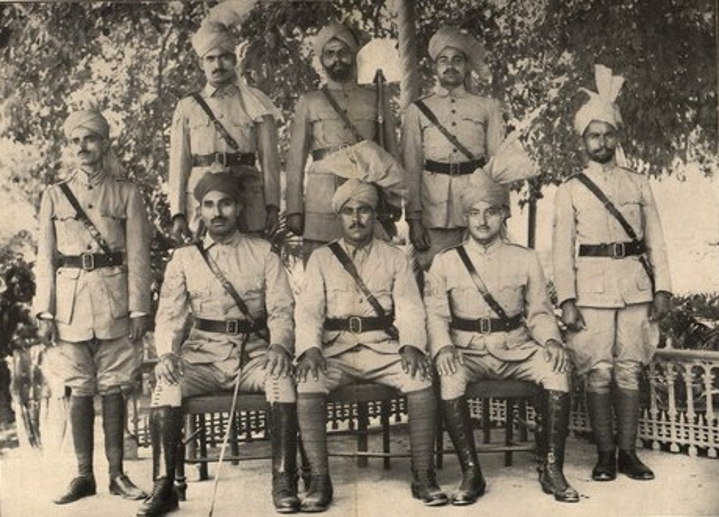
If Azad imported foreign propaganda, Inayatullah Khan Mashriqi grew his own. A brilliant Cambridge-trained scholar who styled himself as “Allama” (honorific title in Islamic societies) he founded the Khaksar movement (khāk (dust) and sār (resembling or like; overall meaning dust like) in the 1930s — a mass paramilitary organisation that at its peak drew enormous numbers across the undivided Punjab and North-West India [7]. The Khaksars wore khaki uniforms, marched in formation, and carried the belcha (a spade) as their emblem — which acted both as a tool of labour, a religious echo, and a symbol of social levelling all at once. Mashriqi led as supreme commander, and his programme fused militarism, discipline, social service, and a reformist reading of Islam. The movement inevitably invited comparisons with the Hitler Youth and Mussolini’s Blackshirts.
But was Mashriqi actually a fascist?The careful answer is not exactly — and that is precisely the point. His movement bore unmistakable structural resemblances to European fascism, and ideas like Social Darwinism which clearly shaped him. Yet it was deeply indigenous, rooted in Islamic revivalism and the anxieties of Indian Muslims, and he never simply took orders from Berlin. He is best understood as a thinker who borrowed European political tools and rebuilt them for local ends. His story also warns about personality cults: because he held total personal control, the movement collapsed almost overnight once the British jailed him in early 1940 during the Second World War. Nevertheless, Mashriqi’s success in mobilising large numbers of volunteers left a lasting mark on late colonial politics..Local Khaksars played a bigger role during the late 1940s especially in undivided Punjab particularly for the All-India Muslim league that ultimately resulted in the eventual partition of Indian subcontinent.
3) The anxious muslim intellectuals: The Kheiri Brothers and Aligarh University
he final case study takes us into the worlds of universities, intellectual networks, and international travel.Abdul Jabbar and Abdus Sattar Kheiri were scholar-activist brothers whose ties to Germany began during the First World War, when they travelled across Beirut, Istanbul and eventually became involved in German propaganda efforts directed at Indian Muslims. Remarkably, as early as 1917 they were among the first to argue internationally for partitioning India into Muslim and Hindu states — decades before the Pakistan movement emerged. After long exile in Berlin during the interwar era precisely to save themselves from being arrested by British authorities for their anti-British activities, they during the 1930s eventually returned to India, where Abdus Sattar settled to teach at Aligarh Muslim University. There a circle of German-trained professors founded a „German Society,“ that ran periodicals partly funded by German companies, and built consular ties to Nazi agents working at the behest of NSDAP inside British India [8]. To British authorities, it appeared to be a Nazi-influenced network operating within a respected university, prompting a crackdown under emergency powers.
The reality, however, was more complex. They were not mere tools of Berlin but ambitious, anxious people pursuing their own agenda for Indian Muslim struggle in post-British era: their focus primarily lay in securing rights for Indian Muslims in regards to their political status especially where they saw a rise of Hindu Nationalist class that in their eyes lay adamant on sidelining Muslim interests in post independent India. This concern helps explain their sustained engagement with Germany, which stretched from the First World War into the Nazi period [9]. When the crackdown came to a close in Aligarh, most professors were released for lack of evidence; however only Abdus Sattar and his wife were interned since his wife was of German origin. Their story captures a broader anxiety among many Indian Muslims — the fear regarding Indian Muslims about their minority status in a post-British India, a fear that made ideas of strength, unity, and a protective state attractive, whatever their origin.
A marketplace of ideas
Across these three cases, influence worked less like an invasion than a marketplace, in which people took what served their needs. Tailored propaganda recast fascism and Nazism for both Indian Muslim and Hindu audiences through notions of a „martial race“ and shared hostility to the British. Print and translation amplified it. Symbols, uniforms, and parades gave abstract ideas physical form. Universities and exile networks carried them quietly into the next generation. Above all, the hunger to be free of empire powered the appeal for many, an interest in fascism was less about ideology than about borrowing whatever seemed strong enough to break colonial rule. Crucially, the borrowing was always selective — and the same period produced fierce critics across India who exposed Nazi networks and helped track them down as well.
Conclusion
The central argument of this article is that fascism was not solely a European phenomenon. with a tidy ending in 1945. This becomes especially clear when examining the experiences of Indian Muslims. By showing how European ideas were received, negotiated, and adapted in colonial India, it joins a growing body of work that treats fascism as a global phenomenon — one that mutated as it travelled, taking on local colours far from its birthplace.
For South Asia, the implications are profound. This engagement did not vanish at independence; it left traces in the region’s intellectual life, and helps explain why, even now, Nazi imagery and the figure of Hitler can carry an oddly positive charge in parts of the subcontinent. Understanding that history is the first step toward understanding the present.
It is also a quiet argument for taking ideas seriously. A wandering propagandist, a Cambridge-trained commander, and two exiled activist turned intellectuals might seem like footnotes. However, through their lives we see how thought itself — carried in magazines, symbols, classrooms, and conversations — shaped the minds of millions who imagined freedom, identity, and their future. Indian Muslim encounters with fascism are therefore not a story of wholesale embrace of the ideology nor a simple rejection, but strategic, anxious, and creative negotiation. Further research is needed to trace the afterlife of these ideas in post-Partition South Asia and to assess their longer-term influence on political thought in the region.
References
[1] Jawaharlal Nehru in an interview with the correspondent of the Rudé Právo, the daily of the Communist Czech Party in July 1938, for more details see: Maria. “Encounters with Fascism and National Socialism in Non-European Regions.” Südasien-Chronik -South Asia Chronicle 2(2012): 350–74.
[2] Esposito, Fernando. “Fascism – Concepts and Theories (English Version).”OPUS 4, August 31, 2017. https://doi.org/10.14765/zzf.dok.2.1111.v1. For more information see: Griffin, Roger. The Nature of Fascism. Basingstoke: Palgrave Macmillan, 1991.
[3] Raza, Ali, and Franziska Roy. “Paramilitary Organisations in Interwar India.” South Asia: Journal of South Asian Studies 38, no. 4 (2015): 671–89.
[4] Zachariah, Benjamin. “A Voluntary Gleichschaltung? Indian Perspectives towards a Non-Eurocentric Understanding of Fascism.” The Journal of Transcultural Studies 5, no. 2 (2014): 63–100. “Global Fascisms and the Volk: The Framing of Narratives and the Crossing of Lines.” South Asia: Journal of South Asian Studies 38, no. 4 (2015): 608–
[5] Fascism with a capital F is often associated with Fascist Italy. Therefore, throughout this article, I will use fascism with a small f for continuity and to follow the conventional academic tradition.
[6] For detailed information see Chapter 5: Marashi, Afshin. Exile and the Nation: The Parsi Community of India and the Making of Modern Iran. Austin: University of Texas Press, 2020.
[7] Malik, Muhammad Aslam. Allama Inayatullah Mashraqi: A Political Biography. Karachi: Oxford University Press, 2000.
[8] For detailed analysis see works of Roy, Baijayanti. “Hakenkreuz, Swastika and Crescent: The Religious Factor in Nazi Cultural Politics Regarding India.” In Religious Entanglements between Germans and Indians, 1800–1945, 253–82. Cham: Palgrave Macmillan, 2024.
[9] Siddiqi, Majid Hayat. “Bluff, Doubt, and Fear: The Kheiri Brothers and the Colonial State, 1904–45.” The Indian Economic & Social History Review 24, no. 3 (1987): 233–63.
About the author: Muneeb Ahmed Siddiqui is a researcher and instructor at the University of Bayreuth, Germany, He holds a MA in Global History from University of Bayreuth. Before turning to academia, he worked in media sector and policy research in Pakistan. He currently teaches courses on Indian history, historical methods and helps facilitate the coordination of the University of Bayreuth’s MA Global History programme.


good one Muneeb.